今日推荐开源项目:《干啥都用脚本 hacker-scripts》
今日推荐英文原文:《The 2020s Will Be the Decade of the Bioeconomy》
今日推荐开源项目:《干啥都用脚本 hacker-scripts》传送门:GitHub链接
推荐理由:这个项目来自一个真实的故事,在一个工程师的生活中,如果任何事情需要90秒以上的时间,他就会选择用脚本解决。根据时间自动发送上班迟到的短信并随机选择理由,扫描邮件并通过查找关键字回复,甚至是自动制作咖啡并在24秒后倒入杯中,而这段时间正好是他走到咖啡机的时间…… 说不定这是对我们的启发呢?
今日推荐英文原文:《The 2020s Will Be the Decade of the Bioeconomy》作者: Alexander Titus
原文链接:https://onezero.medium.com/the-2020s-will-be-the-decade-of-the-bioeconomy-b722420c6bff
推荐理由:你可能你已经看到过最近出现的基因检测的广告了吧,随着生物科技的发展,未来十年被作者称为生物经济的十年,更被美国国防部生物技术部副部长称为下一次科学革命。
The 2020s Will Be the Decade of the Bioeconomy
The assistant director for biotechnology at the Defense Department on why the U.S. needs to go all-in on the next scientific revolution
(Photo: MediaNews Group/The Mercury News/Getty Images)
Alexander Titus currently serves as the assistant director for biotechnology in the Office of the Under Secretary of Defense for Research and Engineering with the U.S. Department of Defense and was previously a management consultant at McKinsey & Company and a data scientist at Amazon and In-Q-Tel. The views expressed here are his alone and do not represent those of the DoD or the U.S. Government.
I spend my time focused on leveraging biotechnology for the public good, and I’m ecstatic about what we’ll see in the coming years. Biotechnology is advancing at an unprecedented rate, and engineered biology, commonly referred to as synthetic biology (SynBio), is taking the world by storm. The past 12 months have seen a major focus on the bioeconomy—the economy based on biology and biotechnology—which promises to be integral to the next decade of growth and opportunity. It’s hard to imagine that artificial intelligence has only been in resurgence since 2012 — less than 10 years. But just as A.I. impacts the digital world, biotechnology impacts the physical world, and over the next decade, we’ll see innovations that rival, or even outpace, A.I.
Biotechnology in the bioeconomy
For thousands of years, we’ve had physical solutions to our problems. I have a heavy rock that needs to get from point A to point B, so I push it, pull it, or roll it. Then, during the industrial revolution, we developed industrial synthetic chemistry. For the last 100 to 150 years, we have combined physical and chemical technologies to accelerate the economy and the quality of life for people around the world.
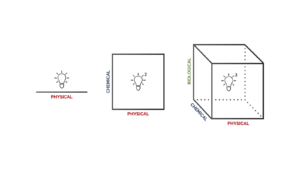
(Biotechnology adds an entirely new dimension of technology development in the bioeconomy. Courtesy of the author)
Now we’re in a new industrial revolution, bringing the bioeconomy to the forefront of technology and economic growth, where we’re combining biotechnology with chemical and physical technologies to revolutionize the world.
Biotechnology opportunity extends beyond health care and agriculture
The U.S. has a robust bioeconomy in health care and agriculture and is a global leader in emerging biotechnologies. It’s these emerging applications in engineered biology, however, that will drive the next wave of growth in the bioeconomy over the next decade. In 2019 alone, we saw scientists and engineers create new therapies for incurable infections and ways to make plants grow in soil that should be too salty. In recent years, the private sector and the government have also partnered to advance regenerative manufacturing and biopharmaceutical development.

(MIT scientists have figured out how to make plants grow in soil that should be too salty. Photo: Fast Company)
Innovations like these in the bioeconomy will increasingly be driven by our ability to leverage synthetic biology and other forms of engineered biology to change the paradigm of how we think about the life sciences.
National interest in the bioeconomy
While biotechnology and bioeconomy have enjoyed major growth over the past decade, in the last 12 months, the bioeconomy has become a central topic in academia, industry, and government. Recognizing the strategic advantage that leadership in biotechnology represents, 2019 saw the launch of the U.S. Promote and Protect the Bioeconomy initiative as well as the Department of Defense establishing biotechnology as an enterprise modernization priority (BIO).
In late 2019 the House passed the Engineering Biology Research and Development Act of 2019 and moved it into the Senate for consideration, and the DoD released a notice of intent to stand up a synthetic biology manufacturing innovation institute, commonly referred to as SynBio MII. The SynBio MII, like the two partner institutes already running, ARMI and NIIMBL, will accelerate the U.S. biomanufacturing industry in support of the bioeconomy.
It’s the combination of a strong private sector, and federal government funding for research and development in this sector, that will drive the next decade of bioeconomy growth.
Ethical, legal, and societal implications (ELSI) of biotechnology
As exciting as new technology is, these advances rarely come without ethical and societal implications to misuse. In the last year, we’ve seen the overstep of biotechnology use with the Chinese and Russian application of human genome editing despite an international call for a moratorium on human genome editing. In addition, in the past year, the New York Times has reported extensively on China’s misuse of genetic information and artificial intelligence to target minority populations. And at the end of the decade, the Department of Defense warned its service members against using at-home DNA kits.
Two lessons about biotechnology innovation
Just as graphical processing units revolutionized our ability to do A.I. at scale, the next decade will see unprecedented advances in biomanufacturing and our ability to produce new products at scale in a global market. We will advance in our ability to manufacture and process large quantities of new products in faster and faster development cycles.
There is no doubt other countries see biotechnology as the future of global leadership. China’s “Made in China 2025” has put biotechnology at the heart of the initiative.
Biotech 2020 and the decade of the bioeconomy
I believe that the U.S. needs policymakers to pass legislation to bolster the bioeconomy and incentivize the growth of companies in the industry. This means the U.S. needs new policies in economics, education, and workforce development. Industry leaders need to understand that the future of their company depends on their ability to adapt and capitalize on the future bioeconomy. The U.S. needs scientists and engineers to bring hard technical skills to the field and finish the job of making biology a true engineering discipline. Influencers, celebrities, and those in the spotlight must voice their support in revolutionizing the world. But most importantly, the U.S. consumer needs to vote with their dollars and show that biotechnology is not just an interesting advance in technology, but mandatory to our future and our vitality.
Originally published at https://alexandertitus.com.
下载开源日报APP:https://opensourcedaily.org/2579/
加入我们:https://opensourcedaily.org/about/join/
关注我们:https://opensourcedaily.org/about/love/
 Mr. Podcast is great. He delivers information instantly, and you can do many other things while listening to him.
 Here’s Mrs. Video.
 She’s an amazing educational resource, and has the ability to condense difficult concepts into digestible pieces. She makes learning fun, and makes you feel like a kid again when you hang out.
 Finally, meet Mr. Book.
 He’s the sage of the group, and has been around for quite some time. So when you’re with him, he’d like a little respect.
 You love Mr. Podcast, Mrs. Video, and Mr. Book.
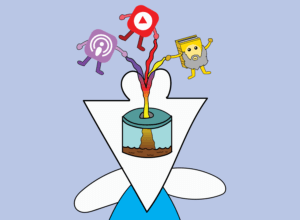 This feels great, but at some point, your mind starts getting a little… full.
 You feel it loading up, but you tell yourself that you must keep going. You can never have enough knowledge, and it’s so easy to acquire anyway.
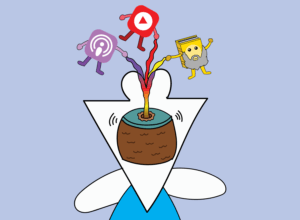 This brain fuel keeps pouring in…
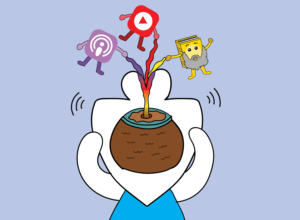 Until one day, you feel fucking nauseous.
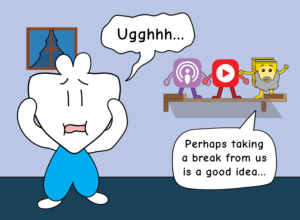 The mind is just like the stomach. Give it too much stuff without the proper release, and you’ll get sick.
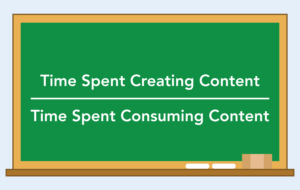 This ratio he spoke of was an elegant way of framing the problem at hand, while also delivering a solution.
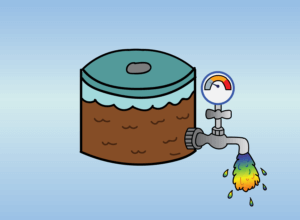 The rate of release is determined by our ratio. The higher it is, the more fuel is processed and poured out. The lower it is, the less fuel is utilized, and the more knowledge remains in your head.
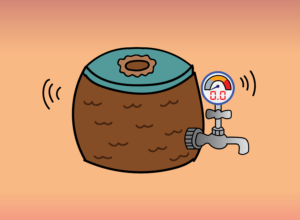
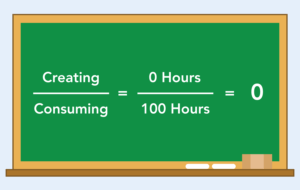 But as we described earlier, a tightly shut valve leads to a restless mind. Having all this information without the proper release is discomforting.
 So the first step is simple: keep the Release Ratio above zero, no matter how small that number is.
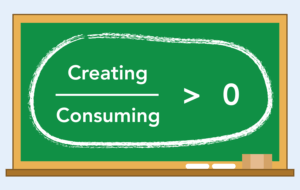 It doesn’t matter if the Release Ratio is 0.1 or 0.001. Start small. Make something that just takes five to 10 minutes of your day — possibly even less. All that matters is that the valve is cracked open.
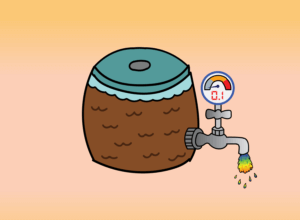 Like most things worthwhile, the hardest part is the start. But remember, all you need to do is to keep the Release Ratio above zero. That’s the golden rule. Once you’re able to do that consistently, then you’re ready for the next step.
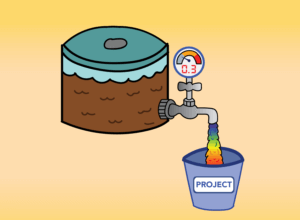 This is an awesome thing, and I can validate this through personal experience.
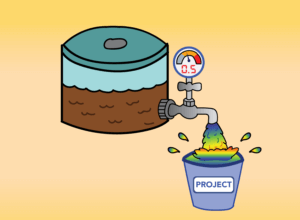 At this stage, you’re spending hours each day creating things, not minutes. Your mind container is being emptied out at a rate that allows for more brain fuel to come in, and this all feels healthy and productive.
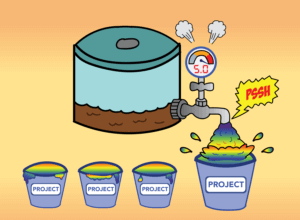 This is a scenario in which the Release Ratio is greater than 1.0, or when you create more than you consume. This is common amongst full-time content creators: writers, artists, designers, entrepreneurs, etc. In fact, it’s probably the default setting for this group of folks.
 When the mind container is empty, there is nothing to draw upon. You can try to create stuff without brain fuel, but the quality of what you make will suffer.
 Like all things worthwhile, there’s an intricate balance to consider. Being a knowledge sponge is fun, but you need the proper release to make it meaningful. Release too much without refilling, however, and you’ll be a wiry ball of fatigue.v
 If you enjoyed this post, consider joining the More To That email list.