• 开源镜像
  • 开源沙龙
  • 媛宝
  • 猿帅
  • 注册
  • 登录
  • 息壤开源生活方式平台
  • 加入我们

开源日报

  • 开源日报第722期:《爬虫集合:awesome-spider》

    20 3 月, 2020
    开源日报 每天推荐一个 GitHub 优质开源项目和一篇精选英文科技或编程文章原文,坚持阅读《开源日报》,保持每日学习的好习惯。
    今日推荐开源项目:《爬虫集合:awesome-spider》
    今日推荐英文原文:《Now you can transcribe speech with Google Translate》

    今日推荐开源项目:《爬虫集合:awesome-spider》传送门:GitHub链接
    推荐理由:收集github上有趣的python爬虫项目, 既可以让爬虫新手体验已经完成的爬虫项目, 也可以进行学习和练手.
    今日推荐英文原文:《Now you can transcribe speech with Google Translate》作者:Sami Iqram
    原文链接:https://www.blog.google/products/translate/transcribe-speech/
    推荐理由:你可以使用 Android 应用程序Google Translate在外语演讲的时候一边听一遍进行转录。

    Now you can transcribe speech with Google Translate

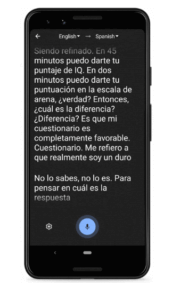
    Recently, I was at my friend’s family gathering, where her grandmother told a story from her childhood. I could see that she was excited to share it with everyone but there was a problem—she told the story in Spanish, a language that I don’t understand. I pulled out Google Translate to transcribe the speech as it was happening. As she was telling the story, the English translation appeared on my phone so that I could follow along—it fostered a moment of understanding that would have otherwise been lost. And now anyone can do this—starting today, you can use the Google Translate Android app to transcribe foreign language speech as it’s happening.

    Transcribe will be rolling out in the next few days with support for any combination of the following eight languages: English, French, German, Hindi, Portuguese, Russian, Spanish and Thai.

    Ongoing translated transcript

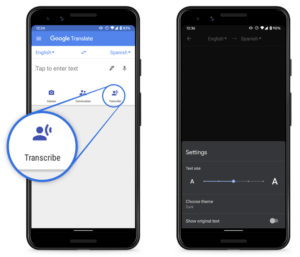
    To try the transcribe feature, go to your Translate app on Android, and make sure you have the latest updates from the Play store. Tap on the “Transcribe” icon from the home screen and select the source and target languages from the language dropdown at the top. You can pause or restart transcription by tapping on the mic icon. You also can see the original transcript, change the text size or choose a dark theme in the settings menu.

    On the left: redesigned home screen, On the right: change settings for a comfortable read

    On the left: redesigned home screen. On the right: how to change the settings for a comfortable read.

    We’ll continue to make speech translations available in a variety of situations. Right now, the transcribe feature will work best in a quiet environment with one person speaking at a time. In other situations, the app will still do its best to provide the gist of what’s being said. Conversation mode in the app will continue to help you to have a back and forth translated conversation with someone.

    Try it out and give us feedback on how we can be better.


    下载开源日报APP:https://opensourcedaily.org/2579/
    加入我们:https://opensourcedaily.org/about/join/
    关注我们:https://opensourcedaily.org/about/love/
  • 开源日报第721期:《模型部署 Kubeflow》

    19 3 月, 2020
    开源日报 每天推荐一个 GitHub 优质开源项目和一篇精选英文科技或编程文章原文,坚持阅读《开源日报》,保持每日学习的好习惯。
    今日推荐开源项目:《模型部署 Kubeflow》
    今日推荐英文原文:《The Future of Coding Is ‘No Code’》

    今日推荐开源项目:《模型部署 Kubeflow》传送门:GitHub链接
    推荐理由:提起机器学习,尤其是深度学习,大家可能会对诸如Tensorflow,Pytorch,Caffee的工具耳熟能详。但其实在实际的机器学习的生命周期中,训练模型(上述工具主要解决的问题)只是整个机器学习生命周期的很小一部分。数据如何准备?模型训练好了如何部署?如何上云?如何上规模Scale?等等挑战随之而来。
    随着机器学习的广泛应用,许多工具响应而生,Kubeflow就是其中之一,其主要提供在生产系统中简单的大规模部署机器学习的模型的功能。
    详见官网:https://www.kubeflow.org/
    今日推荐英文原文:《The Future of Coding Is ‘No Code’》作者:Owen Williams
    原文链接:https://onezero.medium.com/the-future-of-coding-is-no-code-3fdbd35ac15b
    推荐理由:可能在未来,不懂代码不一定不懂编程,看不懂代码不一定看不懂程序,重要的不是某个语言的条条框框,而是思维啊。

    The Future of Coding Is ‘No Code’

    Drag-and-drop tools make anyone a maker

    (Students of a fifth grade of a grammar school use a laptop in class. Photo: Daniel Reinhardt/picture alliance/Getty Images)
    Twenty years ago, learning how a website worked was as simple as clicking “view source” in a web browser — which is how many of today’s developers learned to write code. It was easy to start by hacking together custom MySpace or Tumblr themes, which eventually led to building a website or app, and ultimately a career.

    These days, things are a little different: While the “view source” option is still ubiquitous in modern browsers, sites use code libraries like Facebook’s React that make it easier for programmers to add complex features, but also make that public code undecipherable. The “view source” option no longer reveals exactly how something is put together.

    That means getting into development is harder than ever — it’s not as simple as peeking under the hood anymore. The modern “no-code” movement hopes to reverse that trend with tools for digital design that don’t require custom code. Some, like Webflow, allow anyone to create a website with a drag and drop interface, as if it were being arranged in Photoshop. Others, like Zapier, help nontechnical people make multiple services talk to each other. For instance, even someone who has never heard of an API could use the tool to automatically post to a Slack group every time something is added to a Google Sheet. By combining Google Sheet with a service called Sheet2Site, someone with no coding capability can create an entire website, backed by a spreadsheet.

    Tools for making web products without code have been around in one shape or form for awhile. When I was growing up, apps like Macromedia Dreamweaver (now owned by Adobe) and Microsoft FrontPage provided rudimentary ways to visually build websites without needing to know how to code. But while these early tools provided drag-and-drop editors, they were often simple, static affairs that couldn’t do much at all. Sure, you could build a swishy ’90s website with FrontPage, but with no content management system on the backend, it would be difficult to update. Giving users an option to login or submit a form would require custom coding.

    This new generation of tools is much more capable. It spans multiple services and avoids code altogether. That’s important because rather than learning complex apps like Photoshop, an entire generation has grown up creating things on the web using intuitive tools like Instagram and TikTok, which allow editing images and videos on the fly. These tools bring that same sensibility to projects that previously required learning to code.

    Communities have sprouted up to support these no-code builders. Sites like Makerpad provide tutorials that show off what’s possible by combining these tools, like how to create a paid membership site using Webflow. Others provide courses that show it’s possible to build an entire startup from scratch without writing a line of code, using off-the-shelf tools, demonstrating how to wire it all up.

    Some developers are quick to write off no-code tools for being too simple or not up to the task of real work, but that’s precisely the point: Integrating an API or automating a basic task shouldn’t require custom code every time.

    The shift to no-code building mirrors another big shift in building websites. Just over a decade ago, if you wanted to host a website or create a web app, you’d have to buy a physical server from a company like Dell or HP, install it somewhere, get it set up and connected to the internet, and then think about building a site. Today, most developers never see a physical server at all.

    Instead, they sign up for Google Cloud, Amazon Web Services, or Microsoft Azure, which, with a few clicks, provides a virtual server instead. I’m happy to avoid dealing with a server. Similarly, as someone who has integrated APIs—a process that involves hours of work and learning new techniques—many times in the past, I’m happy to reduce the amount of code I write and ultimately maintain by using no-code services.

    Ultimately, the advent of simpler tools doesn’t preclude writing code entirely; it just provides more people with a starting point—they can dip their toes in the water. It also means less work for even experienced developers. Why code a custom Slack bot when it can be wired together with a few clicks?

    Once they’ve experimented with making something, no-code creators graduate to tools like Glitch, which provides a platform and community for getting started with code, allowing users to remix other people’s apps and build on them.

    And that’s a skill they can use both to automate work and create real products—all without going to a coding bootcamp.


    下载开源日报APP:https://opensourcedaily.org/2579/
    加入我们:https://opensourcedaily.org/about/join/
    关注我们:https://opensourcedaily.org/about/love/
  • 开源日报第720期:《编译器 the-super-tiny-compiler》

    18 3 月, 2020
    开源日报 每天推荐一个 GitHub 优质开源项目和一篇精选英文科技或编程文章原文,坚持阅读《开源日报》,保持每日学习的好习惯。
    今日推荐开源项目:《编译器 the-super-tiny-compiler》
    今日推荐英文原文:《Is Your Code a Bit Flabby?》

    今日推荐开源项目:《编译器 the-super-tiny-compiler》传送门:GitHub链接
    推荐理由:编译器,在技术学习中或多或少的都会听说过,但是除非特别情况,很少需要我们真的需要撬开一个编译器去看看它的内部,这也造成了一个假象——编译器似乎难以理解。这个项目用 JS 解释了编译器是如何工作的,它看起来并没有想象中那么困难……
    今日推荐英文原文:《Is Your Code a Bit Flabby?》作者:Aphinya Dechalert
    原文链接:https://medium.com/better-programming/is-your-code-a-bit-flabby-6ded04a21a84
    推荐理由:由于这些可能存在的小问题,定期回头清理代码是必要的

    Is Your Code a Bit Flabby?

    Dealing with code bloat

    Flabby code doesn’t bode well for anyone. In the short term, everything seems fine. We tell ourselves tiny little white lies that we’ll sort it all out later — but we never do.

    We get sidetracked, sidelined, or switched over to a new project completely. Then we come back to our code and wonder about our life choices at the time.

    But what, exactly is, flabby code?

    Flabby code is the bloat that we code into our work through patterns and architectural decisions. Sometimes we take shortcuts. Sometimes we ignore our bad habits and tendencies until they compound enough to be a major problem. Sometimes we just do things we shouldn’t be doing because we don’t know any better.

    So how do you fix flabby code? How do you train away the flabby pooch that bumps up your final kilobyte size, and turn your app from a heavy and cumbersome thing to a lightweight, superspeedy beauty?

    Going on a Code Diet

    Flabbiness often occurs when you’ve let yourself go in certain areas of your code. There’s more to it than just cleaning your code up. Sure, you can lint your code to make it shorter and better formatted, but there are some things that linting can’t help you with.

    Here are some things you can do to help reduce the flab.

    Create logical names

    Naming things is not exactly rocket science, but many of us still get it wrong. We write long-winded names that end up either being too generic or too specific. Either that or we write things that are so cryptic that three months down the line, we’re convinced that we’re staring at some Egyptian hieroglyphics.

    Code is the bridge between humans and machines. It is the language we use to communicate and do things with the hardware and intermediary compilers and engines. This means that we need to understand it as well.

    Write your function and class names for humans, not as a bunch of acronyms. It only takes one developer and missing documentation to lose all the information associated with it.

    Reduce, reuse, recycle

    Compact components, functions, and classes generally follow the single-functionality rule. The more functionality and features you have, the harder it is to turn your code into a Lego set.

    Because as developers, that’s what we do — we create modular code in order for it to be reused again in the future, for whatever purpose. We reduce our bloat by reducing the components down to the bare necessities and recycling the bigger ones down to a better-suited size.

    Be flexible like bamboo

    Oftentimes, we get too zealous and over-engineer our code. This often creates the issue of long-term rigidity, locking you into a structure that may not suit the trajectory you’re actually on.

    Sometimes, we try to be so over-flexible that our code turns into a floppy gloop that can’t hold its own weight over time.

    Whatever is happening, finding the right balance is akin to scaffolding your app’s architecture with bamboo — a cheap material that can hold immense weight and pressure — over steel frames, which can be harder to modify if plans suddenly change.

    To do this, you need to only scope for the current sprint and refactor the architecture as needed in the next iteration. If the foreseeable future is trustworthy and will certainly happen, you can extend the scope of the scaffold and architecture as needed.

    It’s better to have a working app than one that’s built to withstand hurricanes and tornadoes. Code will change over time, and the revelations and understanding that come with it will help you create better code in the long run.

    Code to the project vibe

    There are conventions and suggestions galore on the internet. Everyone has their own opinions on how projects should be structured, named, and coded.

    Don’t follow them blindly.

    Use your judgment wisely and create against the project vibe. You know the trajectory of your project better than someone on the internet telling you what you should be doing.

    There are some things that you should take into consideration — like what to do to write clean code, plugins to use, and how to structure things — but you and your team need to balance them with what the actual project needs.

    So code to the project’s vibe, not what the internet tells you to do.

    Final Thoughts

    Code pooch is something that can be slimmed down over time, but it takes good processes and long-term commitment to take effect.

    Some people call it a technical debt, except technical debt is more symptomatic of a bigger problem. Code bloat is a feature of technical debt, but it’s not the only one.

    Code bloat happens when we overthink what our code is. We might be aware of clean, lean, and mean ways to code, but sometimes we get over-excited and end up trying to implement everything all at once.

    Save it for your next project.

    Figure out what you need and code to the conditions. Don’t over-code your project. Slim your number of lines down by limiting your features and functionality inside a particular block or set of code.

    Once you get into the habit of doing that, you’re on your way to having code that’s truly lightweight for its conditions.
    下载开源日报APP:https://opensourcedaily.org/2579/
    加入我们:https://opensourcedaily.org/about/join/
    关注我们:https://opensourcedaily.org/about/love/

  • 开源日报第719期:《Awesome-CS-Books》

    17 3 月, 2020
    开源日报 每天推荐一个 GitHub 优质开源项目和一篇精选英文科技或编程文章原文,坚持阅读《开源日报》,保持每日学习的好习惯。
    今日推荐开源项目:《Awesome-CS-Books》
    今日推荐英文原文:《Apple’s COVID-19 response》

    今日推荐开源项目:《Awesome-CS-Books》传送门:GitHub链接
    推荐理由:笔者阅读/收集的优秀计算机科学与技术领域相关的书籍归档,以 {年份}-{作者}-{书名}-{版本} 方式命名文件。阅读书籍永远是最为系统的学习方式,能够帮助我们缓解过于碎片化带来的技能不连贯性与片面性;本仓库以 IT CS 相关书籍为主,同时也会包含一些著名的、有价值的公开课程.
    今日推荐英文原文:《Apple’s COVID-19 response》
    原文链接:https://www.apple.com/newsroom/2020/03/apples-covid-19-response/
    推荐理由:Covid-19的全球传播正在影响我们每一个人.苹果公司作为世界范围内极具影响力的组织, 也在瘟疫中用自己的力量应对这场灾难.

    Apple’s COVID-19 response

    To the worldwide Apple family,

    The global spread of COVID-19 is affecting every one of us. At Apple, we are people first, and we do what we do with the belief that technology can change lives and the hope that it can be a valuable tool in a moment like this. Teachers are innovating to make remote lessons come alive. Companies are experimenting with new ways to stay productive. And medical experts can diagnose illnesses and reach millions with critical updates in the blink of an eye. We are all adapting and responding in our own way, and Apple wants to continue to play a role in helping individuals and communities emerge stronger.

    But this global effort — to protect the most vulnerable, to study this virus, and to care for the sick — requires all of our care, and all of our participation. And I want to update you about the ways in which we are doing our part.

    Giving Back

    Apple’s committed donations to the global COVID-19 response — both to help treat those who are sick and to help lessen the economic and community impacts of the pandemic — today reached $15 million worldwide.

    We’re also announcing that we are matching our employee donations two-to-one to support COVID-19 response efforts locally, nationally and internationally.

    In Our Offices and Stores

    First, I want to recognize Apple’s family in Greater China. Though the rate of infections has dramatically declined, we know COVID-19’s effects are still being strongly felt. I want to express my deep gratitude to our team in China for their determination and spirit. As of today, all of our stores in Greater China have reopened. I also want to thank our operations team and partners for their remarkable efforts to restore our supply chain. What we’ve learned together has helped us all develop the best practices that are assisting enormously in our global response.

    One of those lessons is that the most effective way to minimize risk of the virus’s transmission is to reduce density and maximize social distance. As rates of new infections continue to grow in other places, we’re taking additional steps to protect our team members and customers.

    We will be closing all of our retail stores outside of Greater China until March 27. We are committed to providing exceptional service to our customers. Our online stores are open at www.apple.com, or you can download the Apple Store app on the App Store. For service and support, customers can visit support.apple.com. I want to thank our extraordinary Retail teams for their dedication to enriching our customers’ lives. We are all so grateful to you. In all of our offices, we are moving to flexible work arrangements worldwide outside of Greater China. That means team members should work remotely if their job allows, and those whose work requires them to be on site should follow guidance to maximize interpersonal space. Extensive, deep cleaning will continue at all sites. In all our offices, we are rolling out new health screenings and temperature checks.

    All of our hourly workers will continue to receive pay in alignment with business as usual operations. We have expanded our leave policies to accommodate personal or family health circumstances created by COVID-19 — including recovering from an illness, caring for a sick loved one, mandatory quarantining, or childcare challenges due to school closures.

    For Our Users and Partners

    We know our users depend on Apple products all the time, and especially in times like these. We’re bringing the same creativity and passion to meeting this challenge that we do in everything else we undertake.

    Apple News has launched a new COVID-19 section, where users can be sure that they can find the latest verified reporting from trusted news outlets.

    As you may have seen, our annual Worldwide Developers Conference will be in an entirely new online format this year. We see this as an opportunity to bring together developers around the world in an innovative way.

    Looking Ahead

    There is no mistaking the challenge of this moment. The entire Apple family is indebted to the heroic first responders, doctors, nurses, researchers, public health experts and public servants globally who have given every ounce of their spirit to help the world meet this moment. We do not yet know with certainty when the greatest risk will be behind us.

    And yet I have been inspired by the humanity and determination I have seen from all corners of our global community. As President Lincoln said in a time of great adversity: “The occasion is piled high with difficulty, and we must rise with the occasion. As our case is new, so we must think anew, and act anew.”

    That’s always how Apple has chosen to meet big challenges. And it’s how we’ll rise to meet this one, too.

    Tim
    下载开源日报APP:https://opensourcedaily.org/2579/
    加入我们:https://opensourcedaily.org/about/join/
    关注我们:https://opensourcedaily.org/about/love/
←上一页
1 … 78 79 80 81 82 … 262
下一页→

Proudly powered by WordPress