今日推荐开源项目:《自己创建 build-your-own-x》
今日推荐英文原文:《The Power of Mods》

今日推荐开源项目:《自己创建 build-your-own-x》传送门:GitHub链接
推荐理由:在这个项目中,你能学会如何创造自己的各种工具,引擎,游戏,框架,库……有时候使用别人的,不如自己做一个,虽然这看上去很难。

今日推荐英文原文:《The Power of Mods》作者:Alex Anyfantis
原文链接:https://medium.com/super-jump/the-power-of-mods-ffa56c755750
推荐理由:游戏mod为何有着如此大的力量,有时甚至超过游戏本身?因为无穷的创造力。
The Power of Mods
A rich history of player-created content gave rise to titles like Dreams and Super Mario Maker
 With the release of Media Molecule’s Dreams already behind us, it seems like a perfect time to look back and reminisce about the phenomenon that came before — the period where players were not just consumers of games, but were able to jump into the driver’s seat and build upon their favourite titles. There have been many instances where a group of people (and sometimes, famously, just a single person) — driven by their love for a certain title or genre — have gone on to create their own content within (and for) the gaming community.
What I’m describing here is known as “mods”. For the uninitiated, mod is a shorter term for modification; in other words, an alteration or change that a player makes to an existing game in order to improve or expand upon the original experience. Player-created mods were not always welcomed by developers, especially in cases where fans could profit from their alterations. But over time, developers have found ways to partner with modders (in some cases, developers have incorporated mods directly into their games as part of its “official” content, while in other cases, they have provided tools to support mods and the modding community). The ultimate manifestation of mod culture, then, can be found through titles like Dreams and Super Mario Maker — toolboxes that are built by developers to provide a simplified, user-friendly environment for players to create their own games or game-like experiences.
 Traditionally though, modders have often had very few tools at their disposal, especially when compared to game development studios themselves — this makes their accomplishments all the more impressive. One of the standout examples, in my view, is a mod called NeoTokyo. It involves the creation of an entirely new game based solely on the foundation of Half-Life 2. Of course, NeoTokyo had nothing to do with the game upon which it was built — instead, it was a multiplayer first-person shooter more akin to Counter-Srike, drawing heavy inspiration from futuristic dystopian anime such as Akira or Ghost in the Shell. It’s worth noting, too, that the creators of NeoTokyo — Studio Radi-8 — began their work on the project back in 2004, only for it to be finally released five years later in 2009.
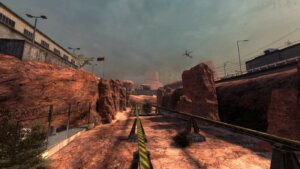 If you think that persistence is impressive, then I must mention Black Mesa, a mod of Half-Life 2 that is essentially a remake of the first Half-Life. The project started with two separate teams who eventually united as one, with work commencing as early as 2004 — the first iteration of the mod itself was available in 2012. That’s right, it took the Crowbar Collective (as they would eventually be known) eight whole years to deliver a playable game. The team hit a large number of setbacks on their journey, but ultimately their dedication and commitment to the project allowed them to deliver a mod that received widespread praise for its high level of sophistication and attention to detail.
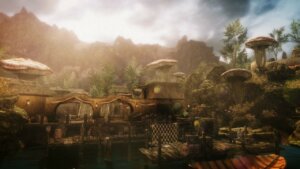 Finally, there’s the ongoing Skywind project. It’s somewhat similar to Black Mesa in terms of ambition, only this time, it’s being built on the back of The Elder Scrolls V: Skyrim. More specifically, fans are attempting to recreate the world of Morrowind (which is the setting of the game’s prequel, The Elder Scrolls III) inside of Skyrim. In fact, the modders have gone a step beyond that, delving deeper into the story of the original game and expanding it to create an overall richer experience for players. This project has been underway for a long time now and there’s currently no telling when it might be released, especially given that the players-turned-developers involved are focused on giving it their utmost attention in order to produce the highest-quality results.
The mods I’ve mentioned so far are earth-shatteringly huge in terms of their scale and ambition, as well as the enormous effort required to execute on the creators’ vision. But of course, there are many smaller — and lesser known — efforts that are equally impressive for their own reasons. One example that comes to mind is Arthur Lopes’ and GTARandom’s attempt to recreate Grand Theft Auto: San Andreas as a playable area inside GTA V.
Whatever form it may come in, it’s always captivating to see fans draw on their passion for gaming and then go on to create entire worlds that we can all dive into and enjoy. Now that far more powerful tools like Dreams are available, there are whole new legions of players who have the power to create the worlds and experiences they’ve always dreamed of. And we, as players, get the privilege of diving deeper into their imaginations. I’m very excited to see what the future holds for what is surely an emerging golden age of player-created content.
下载开源日报APP:https://opensourcedaily.org/2579/
加入我们:https://opensourcedaily.org/about/join/
关注我们:https://opensourcedaily.org/about/love/




 Valve’s view when creating games in the Half-Life series is that they have to solve a problem in game design. I haven’t played every VR game on the market, but the many I tried don’t exactly have hours of quality gameplay and depth. Valve has managed to achieve both with Half-Life: Alyx.
 There is a reason VR has had an unhealthy stigmatization as a ‘gimmick’. VR in its early years wasn’t ready for anything other than indie developments or AAA side projects. The technology was new and in development — it wouldn’t make sense to attempt a complex narrative game unless the system and audience could support it. So VR games started off relatively simply, such as with Eve: Valkyrie’s stationary shooting mechanics, SUPERHOT’s legendarily satisfying gameplay, or Moss’s mouse-to-scale adventure. These VR products that usually retail for $30 or less, provide players with an arcade-like experience. Even with adventure games, the space is more often than not constrained and packaged to be a neat little VR experience, but perhaps not one with the depth and scope to which more die hard gamers are accustomed. This is not to say there aren’t great VR games, but few have come close to the level of detail and variety seen in this VR installation of the Half-Life series.
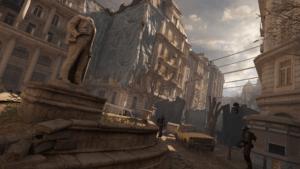
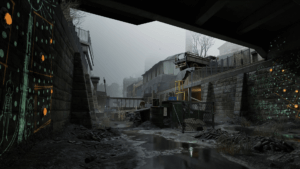 We’ll get to gameplay in a bit, but the most impressive part of the game is no doubt the environment. Even though it seems that City 17 is just another apocalyptic game world, only a few hours in and you realize how different the atmosphere can be in different areas. It can invoke the wasteland, curiosity, caution, warmth, and power, and that in and of itself is an achievement for VR games.
 The gun mechanics are satisfying, but what impressed me most was the pacing and sparseness of the intense encounters with other characters. Early in the game there are few heated firefights, and more puzzles and room for world exploration, but towards the end of the game with the narrative tension turning up, the gunplay and intensity really shine through. Valve utilizes textbook video game pacing in all their games, and it is no different here. It works well and should inspire any developer to spend the time learning the basics of narrative structure utilized across all art forms, the basics of which include rising action, climax, denouement, and resolution. Even the ending gives way to a low intensity but ultimately satisfying conclusion, and that is no easy task.
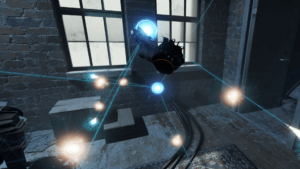 Aside from guns, most of the time throughout City 17 is occupied by puzzles, hazards, exploration, and general character and world interaction. Puzzles can take the form of a hazard, or a piece of machinery you haven’t quite seen before but need to mess around with to understand for a task. These tasks can take the form of a multi-tool minigame, for instance: interacting with a tool that allows you to reconnect circuits or solve various holographic light puzzles. The circuit breaking puzzles are by far my favorite and the most straightforward. They often force the player to explore their surroundings to uncover a hidden branch of the circuit. Other puzzles could have you connect the dots or neutralize lasers by finding the correct placement in 3D space. They are a welcome addition that, although some players might find them frustrating, provides spectacle and a break from intense firefight gameplay.
 Aside from all of this, what carries Alyx — and what has been the bane of most VR games — is the clunky movement and grabbing mechanism which the game rightfully does away with. The developers give you a plethora of options to change how you move. From angle snapping, smooth locomotion settings, to teleport dashing through the game, the player can choose how they want to move around the world. While movement options are great, the gravity gloves are even better. The simple act of aiming, flicking your wrist, and catching an object feels good and solves so many problems about awkwardly reaching for an item out of bounds or on the floor in VR. That box you see 10 feet in front of you, one flick of the wrist and it’s yours.