• 开源镜像
  • 开源沙龙
  • 媛宝
  • 猿帅
  • 注册
  • 登录
  • 息壤开源生活方式平台
  • 加入我们

开源日报

  • 2018年9月9日:开源日报第185期

    9 9 月, 2018

    每天推荐一个 GitHub 优质开源项目和一篇精选英文科技或编程文章原文,欢迎关注开源日报。交流QQ群:202790710;微博:https://weibo.com/openingsource;电报群 https://t.me/OpeningSourceOrg


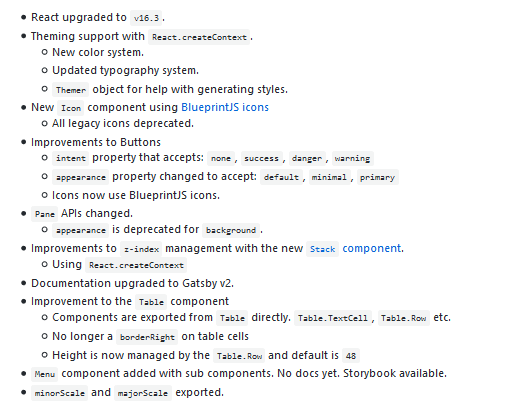
    今日推荐开源项目:《React UI 框架 Evergreen》传送门:GitHub链接

    推荐理由:这个框架里面提供的是各种各样的 React 组件和它们的文档,尽管看上去组件的数量并不算太多,但是实际上你会发现这些组件的使用率相当高。这个项目的第四个版本也即将推出了,将会支持更高版本的 React,如果有兴趣不妨观望一下发展。

    今日推荐英文原文:《Six things that make a great software developer》作者:Janel Brandon

    原文链接:https://medium.com/@janelgbrandon/six-things-that-make-a-great-software-developer-9369ecb6ce3

    推荐理由:有了这六个东西,你就能往一个好的软件开发者的道路上迈进一步

    Six things that make a great software developer

    I’ve been a software developer for about 20 years. I’m not the best or the brightest, but I have had a successful and rewarding career that seems to just keep getting better. In my time, I’ve come to know hundreds of other developers pretty well, and thousands in passing. Why so many? Well — I have been around for a while and I’ve worked on many different teams. I’ve also always been out there in my career, perhaps unlike the stereotypical developer (but honestly I’m not too sure how accurate that stereotype is). I’ve always enjoyed meeting new people in my field, attending conferences, presenting, and just connecting.

    I’ve noticed some things about what makes a great software developer in the process of meeting all of these developers and the teams they work on. There are some qualities that are shared by developers who are successful in their careers, work on interesting problems, and help to build amazing solutions. Perhaps more importantly, it seems these qualities contribute to their overall happiness and satisfaction.

    So — here they are — the six things I think make a great software developer.

    Curiosity
    Great software developers are great problem solvers. To solve problems that matter, you have to have some curiosity — and the more the better. What makes life hard for people? What makes it fun? How can people get access to what they need? What is missing that would make life easier and better for people? You can start by being curious about the answers to these kinds of questions. This will lead you to the interesting problems — the ones that, once solved, will make a significant difference.

    Being curious about why something isn’t working the way you expect when you are developing a project, and about other ways to do what you are trying to accomplish, is important. Being curious instead of being judgemental and critical can mean the difference between the success and failure of a project.

    “Imagination is more important than knowledge. For knowledge is limited, whereas imagination embraces the entire world, stimulating progress, giving birth to evolution. “ ~ Albert Einstein, 1929 October 26, The Saturday Evening Post, What Life Means to Einstein: An Interview by George Sylvester Viereck

    Get curious about new ways of seeing and doing things. This is where the best ideas and solutions come from — curious minds and great imaginations.

    Passion
    When you’re passionate about what you do, whatever that is, you do it better and with more powerful results, without the experience of a lot of effort — even when lots of effort is involved. Passion is why I am excited to go to work when I get up in the morning. It is why it is easy and fun for me to connect with other people to create better and more impactful solutions.

    Passion gives us energy. Passion produces amazing outcomes. I think that great software developers are passionate about coding and problem solving in general. We like to solve puzzles. We like to sink our teeth into a problem, break it down, and work out the best solution. But the cool thing about software development is that your passion for any field or facet of life can fuel your work as a developer, because software development touches every aspect of our lives. If you are a developer and don’t feel passionate about your work — find some other work. Your talents and skills are needed where your passion lies, so go there.

    Resilience
    Like most rewarding things in life, software development isn’t always easy. In fact, most of the time it isn’t easy at all. It is challenging. Even when you’ve been a developer for 20 years like me, you encounter obstacles nearly every day. Every new piece of code I write is broken until it works. Then I change it and often it’s broken again — until I debug it and fix it. I mean — maybe I can count on one hand the number of times I sat down and wrote a substantial piece of code that worked exactly the way I wanted and expected, just the way I wrote it the first time. I know I’m not the only one who feels like I get it wrong more than I get it right — most of the developers I know have shared the same experience with me.

    This is just part of being a developer. Resilience and the ability to embrace failure upon failure and not be deterred is really important. If you get stopped by this kind of frustration, you won’t be a developer for long, or if you are, you’ll stick to what you know, and won’t take on the really interesting problems. You likely won’t contribute very much of value and interest.

    So don’t get discouraged — you are not alone. Keep calm and carry on coding.

    Compassion
    Carrying on from the last topic — compassion is an important quality of a happy developer. Not all great developers are happy, and not all happy developers are great, but the two are related. Who would you rather work with?

    It’s important to have compassion for yourself. You will make so many mistakes. You will have to overcome so many difficulties. If you have compassion for yourself, you’ll be more likely to demonstrate resilience.

    Having compassion for yourself will allow you to feel good even when you make mistakes and encounter obstacles that you don’t quickly overcome.

    If you have compassion for yourself, it’s easier to have compassion for others. In fact, I would challenge you to consider that if you don’t have compassion for yourself, you can’t truly have compassion for others (maybe pity, but not compassion).

    You won’t be the only one making mistakes. Sometimes some other developer will check in a code change that breaks things, and you will spend hours or days trying to figure out what it is that you did to break your code, only to find that it was your dear colleague who introduced the problem. When that happens (and it will happen), if you can have real compassion for your work mate, it will just be another thing the team has gone through together and overcome, instead of some reason to judge, blame, or shame. It will make the team stronger, and what you create together will be greater.

    Humility
    Sometimes we get it right — and boy does that feel good! You solve a hard problem, or improve performance of your application by heaps, or finally master that framework that you’ve only kind of understood for so long. It can be tempting to feel like some kind of coding god in those moments, and there’s nothing wrong with that — enjoy the victories! Just remember there is still a lot to learn, and that victory was likely earned after a lot of hard work rather than because of some innate ability. We are all learning all the time, in this field perhaps more than most.

    Own your accomplishments, but remain humble. Don’t assume that just because you know more about something than someone else that you are somehow more important or valuable than that person.

    Staying humble keeps us open to learning from EVERYONE and EVERYTHING.

    … And no one wants to work with an arrogant prick. Humility makes you more available and accessible to the people you work with, allowing for more meaningful and genuine connections, which means you’ll create better solutions together.

    A sense of humour
    This one isn’t absolutely necessary — but it really helps. If you take yourself or situations too seriously, you are going to suffer a lot as a developer.

    For example … when your staring down a release deadline and the build is broken and you don’t know why and your manager is asking when deploy will happen, or your network suddenly decides to stop working when you’re trying to do a demo in front of stakeholders that means the life or death of your current project, or your hard drive dies and you realise you never pushed those last commits that took you three days to develop to the remote repo— a sense of humour comes in handy.

    Don’t take anything too seriously. The release will deploy, another project opportunity will come, and you will write that code you just lost faster the second time anyway, right? Don’t sweat it. Have a laugh, go for a walk or a run, play some video games, or meet some friends at the pub — whatever helps to remind you there is more to living than whatever situation just went up in flames.

    Let your happiness come from within instead of making it depend on any particular situation or outcome.

    So there’s my advice. The best part about these six qualities is that they are available to everyone. I’m not saying that everyone can or should be a software developer, but I am saying that if you are a software developer and want to be a great one, these six things will help you to be your best.


    每天推荐一个 GitHub 优质开源项目和一篇精选英文科技或编程文章原文,欢迎关注开源日报。交流QQ群:202790710;微博:https://weibo.com/openingsource;电报群 https://t.me/OpeningSourceOrg
  • 2018年9月8日:开源日报第184期

    8 9 月, 2018

    每天推荐一个 GitHub 优质开源项目和一篇精选英文科技或编程文章原文,欢迎关注开源日报。交流QQ群:202790710;微博:https://weibo.com/openingsource;电报群 https://t.me/OpeningSourceOrg


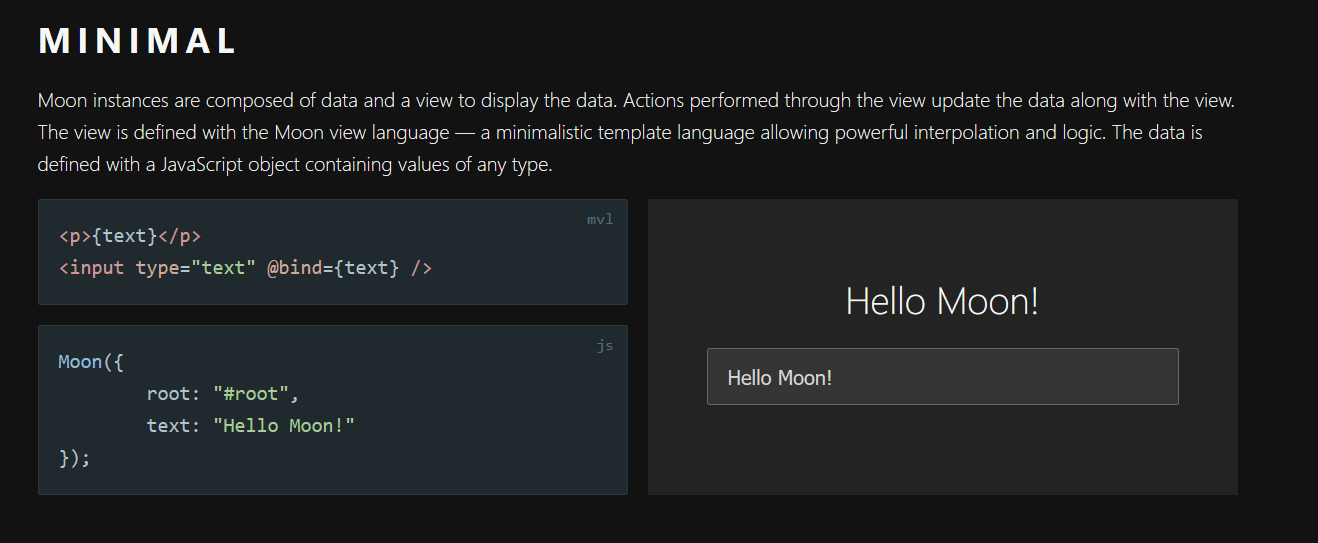
    今日推荐开源项目:《一个 JS 的 UI 库 Moon》传送门:GitHub链接

    推荐理由:这是个 UI 库,它的实例把视图和视图中的数据分开来,而它的实例则由它自己使用的一种模版语言 Moon view language(mvl)定义。它还可以识别程序中的动态部分并且在需要的时候更新它们。唯一的一点不足就是它提供的例子比较基础,如果想要实验更丰富的功能的话需要自己动手了。


    今日推荐英文原文:《Press Releases》作者:Baseball Tomorrow Fund

    原文链接:https://baseballtomorrowfund.mlblogs.com/pr-101-press-releases-171097911b1a

    推荐理由:关于写新闻稿的一些方法,兴许这在开发软件的时候派不上用场,但是当你需要宣传的时候,试试这个效果会不错

    Press Releases

    What is a Press Release

    A press release is a brief news story directed at members of the media announcing something that is newsworthy.

    Press releases are often referred to as:

    • News Releases
    • Media Releases
    • Press Statements
    • Video Releases

    A press release is an official statement distributed to media outlets, written with the intention to compel the reporters to:

    • Seek more information
    • Cover an event or circumstance
    • Write an article or story

    Writing a Press Release

    An effective press release announces content that is newsworthy: current, relevant information of interest to the target audience. Not all stories are newsworthy, which makes determining the importance of an event crucial. This can be accomplished by answering the following questions:

    • What is the story?
    • Who does the story affect? Who does it benefit?
    • Where is it happening?
    • When is the timing of the story? (Does the timing add significance?)
    • How did this story come about?
    • Why is this story newsworthy? Why is it important?

    Remember the following when drafting a press release:

    • The target audience dictates the angle of the story. If there are multiple audiences, consider multiple drafts of the same release.
    • Keep the press release to one page by eliminating repetitive or non-essential information. Use concise sentences.
    • Do not write the press release in the first person (i.e. “We will hold a clinic…”) Write in the third person (i.e. “The ABC League will hold a clinic…”)

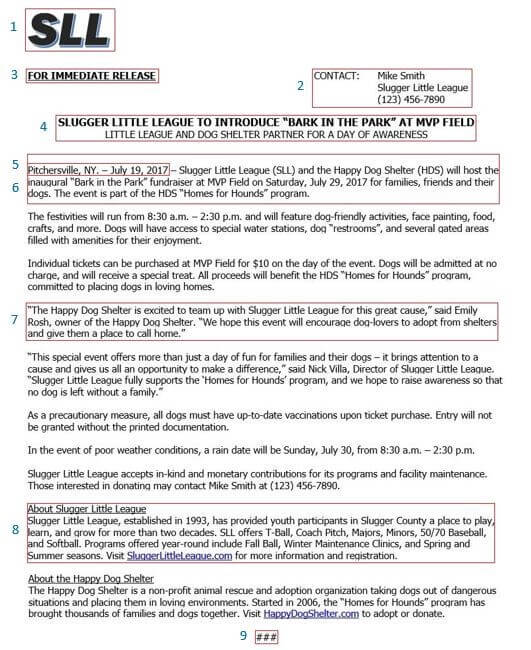
    You do not have to be a public relations professional to write a press release, and you do not have to pay a writer. Please find below a basic press release template and example:

    1. Letterhead/Logo: Include your organization’s logo at the top of the press release to help identify the organization to the media.

    2. Contact Information: Designate a contact person to field questions about the release.

    3. “For Immediate Release”: Immediate release means that anyone can share the information as soon as the release is made public.

    4. Headline/sub-headline: A succinct statement about the story to create interest. The sub-headline describes the headline in a little bit more detail.

    5. Dateline: The release date, as well as the city and state where the press release originated. Will precede the first body paragraph.

    6. Body: Provide the who, what, when, where, why and how of the story. Additional paragraphs will explain in further detail. A few important notes:

    • Summarize the subject and purpose of the announcement.
    • Use concise sentences.
    • State the facts.
    • Include a call to action. Examples: “Call XXX-XXXXX to register.” “All are welcome to attend.” “Donate online at www.xxxxx.com.”

    7. Quote: Add quotes from a representative of your organization and other partners.

    8. Boilerplate: A boilerplate is standard background information about a company, organization or individual. Learn how to write a boilerplate.

    9. Close: The symbol ‘###’ has traditionally been used at the end of the press release to indicate to media that the release has ended.

    Distributing a Press Release

    Getting a press release into the right hands is essential. In addition to the local newspaper sports section, consider other news sections at the newspaper as well as local TV, radio stations and local bloggers:

    • Family & Kids
    • Lifestyle
    • Features
    • Things to Do/Events/Community Calendar

    In addition to distributing the release to the local media, distribute the release in other ways:

    • Post the press release on your organization’s website and social media.
    • Email the release to your internal database, sponsors, donors and partners.
    • Email the release to the directors of local youth service agencies and community centers.
    • Email the release to school principals and athletic directors.

    Keep in mind the following tips in the distribution process:

    • Quality over quantity. Sending press releases too often can result in content losing value. One or two engaging releases is better than 10 bland ones.
    • Build relationships with reporters. Know their work, be respectful of their time, and interact face-to-face if possible. Build relationships with members of the local media.
    • Consider the publications. Target publications — such as blog and magazines — that are have your desired audience.

    Suggested Topics

    As a youth baseball/softball organization or team, the distribution of a press release may be worthwhile to announce:

    • Field renovation or construction projects
    • Fundraising projects or events
    • Introduction of a new program (age group, division, etc.)
    • New or redesigned website
    • New sponsorships and partnerships
    • Noteworthy news — retirement, new personnel, anniversaries
    • Organization charitable contributions or community service projects
    • Promotion of upcoming tournaments or games
    • Receiving an award, player award winners
    • Schedules — program registration dates, tryouts, start/end of season
    • Scholarship opportunities for participants
    • Skills clinics, camps or seminars (field maintenance, coaching, etc.)
    • Volunteer opportunities


    In conclusion, a press release can be an effective and low-cost way to promote your organization’s good work and services and to reach potential participants, donors and sponsors. Drafting and distributing a professional, concise press release is well-worth the time.

    Learn more about public relations and how to plan a successful media event.

    Good luck!

    Sources

    Levine, Sheldon. “6 best practices for distributing press releases.” My PRSA. 1 July. 2013. Web. 10 July. 2017.

    Tan, Miranda. “Why Press Releases Are More Important than Ever.” LegalZoom. Web. 9 July. 2017.

    “The Nine Components of a Press Release.” Northwest Center for Public Healthy Practice. 5 July. 2013. Web. 10 July. 2017.

    Wolfe, Lahle. “What Are Press Releases and What Is Their Purpose?” The Balance. 11 June. 2017. Web. 9 July. 2017.

    Wynne, Robert. “How To Write A Press Release.” Forbes. 13 June. 2016. Web. 9 July. 2017.


    每天推荐一个 GitHub 优质开源项目和一篇精选英文科技或编程文章原文,欢迎关注开源日报。交流QQ群:202790710;微博:https://weibo.com/openingsource;电报群 https://t.me/OpeningSourceOrg

  • 2018年9月7日:开源日报第183期

    7 9 月, 2018

    每天推荐一个 GitHub 优质开源项目和一篇精选英文科技或编程文章原文,欢迎关注开源日报。交流QQ群:202790710;微博:https://weibo.com/openingsource;电报群 https://t.me/OpeningSourceOrg


    今日推荐开源项目:《终端操作录制器 Terminalizer》传送门:GitHub链接

    推荐理由:你应该经常在 GitHub 上的某个项目中看到一段一顿操作猛如虎的终端命令演示 Gif,大多数时候它们都用来切实的介绍某些功能,然后你手痒了,你也想给自己的项目来一段猛如虎的操作演示,然后你就需要找一个录屏软件什么的……噢!我的老伙计,我敢打赌这里有个好的令人飞天的东西可以代替那麻烦的录屏软件,我向上帝保证。你瞧瞧这有意思的小项目,它不仅能够帮你做出精巧的 Gif,还能给你提供各种各样的配置哩,比如各种主题,加水印这些,我向上帝发誓,你肯定能做出个好看的 Gif 来。

    无边框版:

    水印版:


    今日推荐英文原文:《10 Quick Tips for Writing Great Web Content》作者:Tim King

    原文链接:https://medium.com/@timkingwriter/10-quick-tips-for-writing-great-web-content-beee68b9c686

    推荐理由:10个小建议,献给正在绞尽脑汁想办法给网站上增添文章的你

    10 Quick Tips for Writing Great Web Content

    Writing content for the web is very different that writing a business paper, technical document or essay. Getting it right can take time and effort but can make all the difference. It can often be the dividing line between deeply engaging with an individual or causing them to become disinterested in your information.

    Below are a few tips to help you shape your content to better engage and inform, while still conveying your key message.

    Understand How Users Read on the Web

    Users read differently on the web, unlike when they are reading a book from cover to cover.

    On the web, users don’t read word for word. They skim content, trying to get a quick impression of what it’s about. They scan for the bits they are interested in and ignore the rest unless highly engaged.

    You need to understand how users read on the web, then write content in a style that makes it easy for them.

    Know Your Audience

    Who are you are writing for? What are their needs? What will they come to your web page to find or achieve? What is their level of expertise? Build a profile of your various audience groups. Focus your content around your users’ needs and tasks, not around yourself or your organisation.

    Embrace user-centric content writing.

    Write Content that is Easy to Skim & Scan

    • Be direct
    • Limit each paragraph to one key concept
    • Use meaningful headings
    • Use bullet points and numbered lists
    • Include summaries or overviews

    Keep Your Wording Short & Simple

    Be brief and concise. Reduce your word-count to a minimum. Write clearly and simply. If you are writing for an expert audience explain your terms. Provide easy ways for non-experts to find out what your acronyms and difficult expressions mean. Give your users links to simple background information, so that the most casual visitor can work out what you are talking about.

    Put Your Most Important Information First

    Information that’s most important to your web visitors is often a simple statement of what you do. Once they understand what you do, they might want to know some important details. And then, maybe they’d like to know some background information.

    Write in Common Language

    We think we know what SMS means but what if there is more than one meaning for SMS?

    Always use words that users will effortlessly understand. You don’t need bombastic and fanciful words to impress people. You’ll impress people when you use simple words to get a complicated idea across.

    Make Your Copy Easy to Read

    • Use short paragraphs — four sentences maximum
    • Use short sentences — twelve words on average
    • Skip unnecessary words
    • Avoid jargon and overly technical terms
    • Avoid the passive tense
    • Avoid needless repetition
    • Address your web visitors directly. Use the words you and your
    • Shorten your text

    Test then Refine Your Content

    First test it yourself. Review each web page or article while imagining how it reads to a new user.

    Test it on users to learn what works and what causes difficulties.

    Test your content on different audience groups with different levels of knowledge.

    Test web page performance in all common browsers. Test, refine, test, refine, test …

    You get the idea.

    Build Trust

    • Be factual and accurate
    • Include only content which conforms to the purpose
    • Protect privacy and respect copyright
    • Keep your content up to date
    • Publish your contact details. Provide users with a sense of knowing who is behind the content
    • Spell-check your content
    • Invite people to report errors, then fix them

    Make Users Act Without Saying “Click Here”

    The challenge is to make your links communicate “click here” without actually saying “click here,” and there are many ways to do this. It will take some thought and effort on your part, but in the end, users will benefit with a better experience.

    A great way to do this is to add links to the relevant words and phrases within your content. This way the link remains contextually relevant, and you avoid the notorious “Click Here”.


    每天推荐一个 GitHub 优质开源项目和一篇精选英文科技或编程文章原文,欢迎关注开源日报。交流QQ群:202790710;微博:https://weibo.com/openingsource;电报群 https://t.me/OpeningSourceOrg

  • 2018年9月6日:开源日报第182期

    6 9 月, 2018

    每天推荐一个 GitHub 优质开源项目和一篇精选英文科技或编程文章原文,欢迎关注开源日报。交流QQ群:202790710;微博:https://weibo.com/openingsource;电报群 https://t.me/OpeningSourceOrg


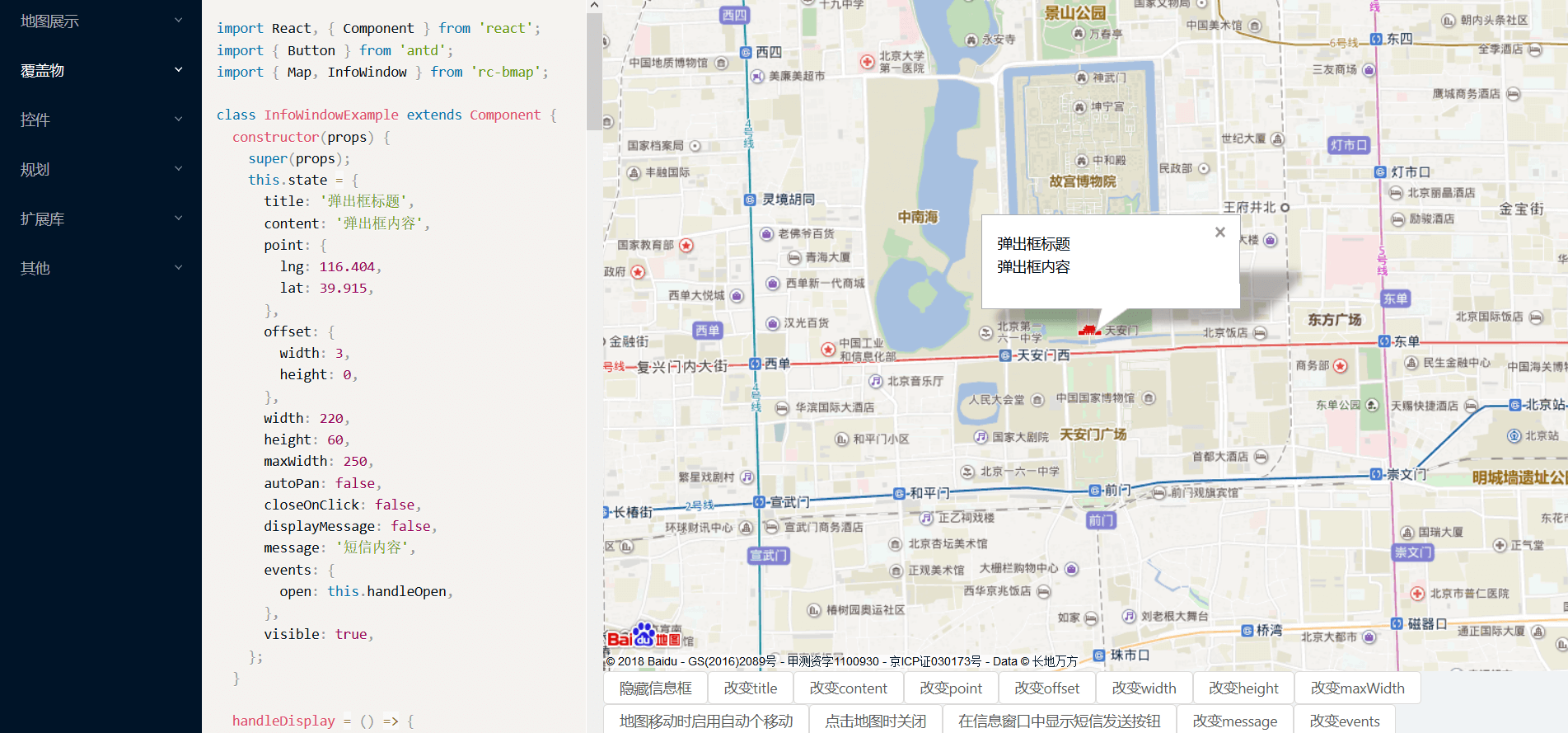
    今日推荐开源项目:《React+百度地图=React BaiduMap》传送门:GitHub链接

    推荐理由:在有些时候你兴许需要一个地图放在你的网页上,如果你刚好正在使用 React ,那么这个 React 的百度地图组件就可以帮上你的忙了。你可以像对待一个 React 的组件一样操作它,而且所有的百度地图 API 都还可以调用,如果有需要你肯定该考虑这个。


    今日推荐英文原文:《In Ten Years: The Future of AI and ML》作者:Foursquare

    原文链接:https://medium.com/foursquare-direct/in-ten-years-the-future-of-ai-and-ml-fa68a527f378

    推荐理由:十年之后,AI 和机器学习将会变成什么样子呢?

    In Ten Years: The Future of AI and ML

    When you take a minute to stop and look around, the technological advancements of today could be perceived as something out of a futuristic novel. Cars are learning to drive, hands-free devices can turn on your lights or toast your bread, and flying drones are circling the skies. This is 2018. While the manifestation of Artificial Intelligence (AI) and Machine Learning (ML) haven’t been realized, impressive progress has certainly been made.

    As a location technology platform, we at Foursquare understand the power that something like AI and ML can have on the way people live and move throughout the world. Take for instance, our own Pilgrim SDK technology, the most sophisticated contextual awareness engine. Our robust understanding of where consumers go in the physical world via Pilgrim was developed using machine-learned algorithms, enabling brands to gain a profound understanding of their audience, drive foot traffic and increase engagement. Technology can change the way people interact with their surroundings forever.

    This led us to ask, what can we do today that we couldn’t do 10 years ago? And what does the future look like from here? While none of us have a crystal ball, that doesn’t stop us from making educated predictions. We sat down with a group of hand-selected fellow tech experts spanning a myriad of data-driven industries and gave just one prompt:

    In 10 years, AI/ Machine Learning will…

    Here’s what they said. (Spoiler: You’re going to want the future to hurry up.)

    1) Increase security

    “Drones are going to change the way we live. I think of drones now as the equivalent of what phones were in the 90’s. Drones open up the ability to transport things through the air over short distances and in complex spaces, which is just not something we have another solution for today. Whether that’s package delivery, or emergency response, or delivering medical products urgently — all of those things become possible immediately. One of the amazing things about drones is that they fly. The idea that you can have something routinely inspect places that are hard to look at will make our world dramatically safer. It will be another way in which drones will help us realize this future vision a lot of us have of what’s going to happen — this network of autonomous drones flying around, taking care of things, and interacting with us. It will bring an immediacy to what they’re doing in the same way a smartphone in your hand made that change so readily apparent.” – Nicholas Horbaczewski, CEO & Founder at the Drone Racing League

    2) Generate new services (and potentially social issues)

    “Artificial intelligence really means the extension of our ability to solve problems and to generate new ideas. It’s quite possible that 10 years will get us to an inflection point, after which we will see advancement at an unprecedented rate. AI and and robotics will have been assimilated into business operations and will be having a major impact on efficiency in organizations. Entirely new AI-based products and services will have created new consumer and industrial markets. At the same time, AI will bring along new challenges, perhaps most importantly increasing inequality and possibly unemployment as routine, predictable types of work are automated. There will also be critical challenges in areas like privacy, security, algorithmic bias and military applications of AI. Ten years from now, a vibrant debate about these issues will have likely come to the forefront of our political and social discourse. Finding a way to address these issues on behalf of humanity will soon be one of the defining challenges for the coming decades.” – Martin Ford, Futurist & NY Times bestselling author of Rise of the Robots

    3) Empower businesses

    “The consumer-facing applications of AI and ML feel stuck to me, relegated to doing what humans can already do or, more critically, only what we trust them to do. Over the next ten years, I think we’ll start seeing trust barriers decrease, and as a result, dependence on AI powered algorithms and machines will increase. We started learning this lesson years ago building our consumer applications. If you’re going on a trip to Paris, for example, you’d trust almost anything your friend recommends, even if they’d only been to Paris once for a short trip, just because they said so. In the same situation, we use sophisticated ML techniques to deliver extremely personalized recommendations — but algorithms don’t get the benefit of trust like a friend. In order to gain user trust, we had to try and explain the what the AI ‘thought,’ which defeats the power of it. Today, these ideas are starting to grow in acceptance and expectation, as brands such as Foursquare continue to use ML to build location-aware technology that push the boundaries of mobile capabilities—and gives developers, analysts, marketers and beyond a unique way of understanding and interacting with their users. The industry excitement around this technology and the rich experiences built on top of it I hope and believe represent the tides of change.” – Matthew Kamen, SVP of Engineering at Foursquare

    4) Improve healthcare

    “When it comes to healthcare, there’s a lot machines can do to help the doctor. I don’t see a future where we actually don’t have doctors guiding, but a lot of the busy work doctors have to do is better done using artificial intelligence. If you think about a doctor’s career, thirty or forty years, the number of patients you can see during that time period is very limited. Many doctors are burnt out, overworked — it’s a serious issue. They also don’t have time to keep themselves up to date on the most recent research, treatment techniques, and advancements in medication. Machines can play a very important role here. Artificial intelligence can access a much larger set of patient data of how they were treated and what the outcomes were. You can imagine machines being in a much better position, because machines can start doing the busy work around the diagnosis and humans can actually interact with the patient and work with artificial intelligence to improve outcomes. That, in my mind, is super exciting.” – Serkan Kutan, CTO at Zocdoc

    5) Facilitate sustainability

    “Artificial intelligence is going to impact every single industry and everything that we do. On a bigger level, areas like sustainability, climate change, environmental issues — they are becoming more at the forefront of everybody’s minds as we move more into the 21st century and think about the huge challenges we need to tackle like population increases, urbanization, and energy. There’s so many different areas within urbanization that touch on city planning. We can do that much more efficiently once we can track the movements of residents within cities, and once we can map which areas we can use to improve the density of cities. In the AI floodgates conversation, I’ve seen in the past six months or so a lot more companies wanting to focus on AI instead of just thinking about the quick goals of making workloads and businesses more efficient. If we look at the bigger picture of AI for good, then it connects us with more purpose and meaning.” –Nikita Johnson, Founder of RE.WORK

    6) Blend the lines of digital and physical

    “Personally, I’m most interested in furthering spatial computing. When you live in a world where your computer is not just bound to a specific device, but can be anywhere you want to put it, it means computers will have to react to humans much more intelligently than they do now. Right now, if you do something wrong today, your computer throws up an error, you close it, and that’s it. But imagine if, for example, you had a full-scale game that was in your apartment and something went wrong. Where does the dialog box go then? Should there be one at all? There are a lot of open questions around how humans will want to interact with their computers. For example, Foursquare did a really great job with having with having location-based notifications designed to give you the right information at the right time. There are many, many applications that should be making use of that kind of awareness today. And in the future, having these really intelligent ways of surfacing information are going to move from ‘nice-to-haves’ to essentials. And I, for one, will be looking forward to that — because I want computers to be smarter already.” – Timoni West, Director of XR Research at Unity Technologies

    7) Make us smarter

    “Computational power is going to continue to increase, giving us more power to train our models. The amount of data being created is going to continue to grow exponentially as well allowing us to monitor more elements in our platforms and our world. Combine the two together with AI, and it gives us the ability to be able to make more intelligent projections on future behavior and events as you can train more intelligent models and knowledge systems. However, in the financial services industry, regulatory pressures could actually curb the power of AI to some degree by siloing off information used to train models, thus cutting off one source of fuel AI needs to thrive— slowing its ability to make an impact. I believe people’s worries about AI becoming all powerful are unfounded. Ultimately, training an AI platform — it is very much like molding a child. If you treat it the right way and teach it the right things, train it to know what’s right and wrong, it will inherently grow up to become a productive member of society that cares about people and the future. Just like any one of us.” – John Stecher, Group Managing Director at Barclays Investment Bank

    8) Inspire artists

    “In ten years, there will be some sort of algorithm involved in most decisions made, big or small. Artists like myself can get involved in artificial intelligence. While such a mission may sound daunting, it’s really about starting to use it, exploring the capabilities of algorithms as well as what they can express through AI systems. I encourage artists to try to use AI to create something beautiful and expressive, the way they would with any other medium. However, I never want to see the technology become the artist. We must think about AI as a tool for the augmentation of human thought and creation and make every effort not to turn the reigns of creativity or ethics over to the machines. When deploying AI (individuals, businesses, governments, etc.) must consider how to maintain a sense of civility, creativity, and equity in the AI system being released into the world. For industries, the driving question is how can AI be used to increase productivity while respecting human diversity, dignity, and our cultural specificities?” –Stephanie Dinkins, Transdisciplinary AI Artist


    每天推荐一个 GitHub 优质开源项目和一篇精选英文科技或编程文章原文,欢迎关注开源日报。交流QQ群:202790710;微博:https://weibo.com/openingsource;电报群 https://t.me/OpeningSourceOrg
←上一页
1 … 213 214 215 216 217 … 262
下一页→

Proudly powered by WordPress