• 开源镜像
  • 开源沙龙
  • 媛宝
  • 猿帅
  • 注册
  • 登录
  • 息壤开源生活方式平台
  • 加入我们

开源日报

  • 开源日报第982期:《代码音乐 sonic-pi》

    17 12 月, 2020
    开源日报 每天推荐一个 GitHub 优质开源项目和一篇精选英文科技或编程文章原文,坚持阅读《开源日报》,保持每日学习的好习惯。
    今日推荐开源项目:《代码音乐 sonic-pi》
    今日推荐英文原文:《Here’s How Consistency Improves Your Code’s Readability》
    今日推荐开源项目:《代码音乐 sonic-pi》传送门:项目链接
    推荐理由:这个项目将创作音乐与写代码融合到了一起——你可以通过代码来创造音乐了。操作这些代码并不需要很多乐理知识,而这些语法与常用的编程语言的差别也不算太大,如果只是想要在碎片时间玩一玩的话,甚至可以只通过不断调整与组合现有的示例代码来创作自己的旋律。
    今日推荐英文原文:《Here’s How Consistency Improves Your Code’s Readability》作者:Yong Cui
    原文链接:https://medium.com/better-programming/heres-how-consistency-improves-your-code-s-readability-644d64b142b5
    推荐理由:一致性能够为代码可读性做出的贡献

    Here’s How Consistency Improves Your Code’s Readability

    There’s nothing more valuable than a consistent engineer

    Writing code is difficult. Your code can’t run if your syntax is wrong, if your parameters are wrong, or if your data are corrupted. There are hundreds or thousands of things that make your code unable to execute.

    Writing readable code is even more difficult. After learning the language and pertinent frameworks, you’re finally able to write some code that your computer understands. However, chances are that others can’t read your code — even with the help of your helpful (at least in your mind) comments.

    The problem of code’s readability doesn’t happen only to junior developers, but also to seasoned developers if they haven’t learnt the right habit to begin with. In this article, I’d like to share the tips that I use to write code that is readable and thus maintainable in the long term by following just one principle — consistency.

    1. Style Consistency

    Different programming languages can have their own style guidelines, some of which are even part of the syntax. It’s always a good practice to respect these guidelines, although I can appreciate that developers can have certain variations in their code. However, within the scope of any project, developers should adopt the same coding styles.

    For instance, you need to declare arrays in your project. Many of the arrays have multiple items. One way to have style consistency with better readability is to have these arrays occupy multiple lines, with each line having just one item, as shown below. Readability is reduced if you sometimes declare a long array using a single line while sometimes using multiple lines.
    array0 = [
        "item_long_var0",
        "item_long_var1",
        "item_long_var2"
    ]
    
    array1 = [
        "item_long_var0", 
        "item_long_var1", 
        "item_long_var2"
    ]
    
    For another instance, we often need to call functions with multiple parameters, which results in the invocation exceeding the recommended line width. Some developers may adopt the following style.
    do_something(param0=0, param1="hello", param2=["1", "2", "3"], param3=[2, 4, 5],
                 param4="Item", param5="Hello World")
    
    do_something(param0=100000, param1="hello world", param2=["1", "2", "3", "4", "5"],
                 param3=[1, 2, 4, 5], param4="Long Item", param5="Hello World")
    
    Function Invocation

    However, with the varying lengths of individual parameters, it’s harder to eyeball what parameters are passed for different function invocations. Instead, the following style has better readability, which is particularly useful when functions involve multiple parameters.
    do_something(param0=0,
                 param1="hello",
                 param2=["1", "2", "3"],
                 param3=[2, 4, 5],
                 param4="Item",
                 param5="Hello World")
    
    do_something(param0=100000,
                 param1="hello world",
                 param2=["1", "2", "3", "4", "5"],
                 param3=[1, 2, 4, 5],
                 param4="Long Item",
                 param5="Hello World")
    
    Function Invocation — Better Readability

    Certainly, there are many variations in styles that your code can adopt. But I just want to reiterate: Keep your style consistent using the one with the best readability.

    2. Consistent Naming

    No matter what programming language you use, it’s so essential to follow the naming conventions. When it comes to naming, don’t reinvent the wheel. Think about your own name or your children’s names. You probably follow your culture’s convention, right? You don’t want to call your daughter David or your son Jessica — the same principle should apply to the naming in your code too.

    Specifically, consistent naming applies to three aspects.
    • First, use camel case or snake case consistently following your language’s convention. For instance, in camel case naming, instance variables are usually named as varName, while classes are named as ClassName. In addition, these names should clearly reflect what they are. For instance, the names of functions should indicate the job they’re performing. The names of classes should show the data they’re holding.
    • Second, related variables, functions, or classes that do related things should be named similarly to reflect their close relationship. For instance, suppose that you’re creating multiple instances for a Team class. It’s not a good idea to call them t0, tm1, team2, and tem3. Instead, they should be called team0, team1, team2, and team3. Don’t be afraid of creating a long name — a long meaningful name is always better than a short unclear name.
    • Third, file names should be named consistently. It’s apparent that file names should reflect their content. But beyond that, consistent naming of files makes it easier for you to understand what they are. For instance, in Swift, we can name a series of files of subclass UIViewController so that they end with ViewController, such as UserProfileViewController and UserDashboardViewController.

    3. Structural Consistency

    We write code at various hierarchical levels. Some lower blocks of code can include functions, loops, and so on. Some higher blocks include classes and modules. It’s important for us to write these different levels of code in a consistent manner — structurally.

    Let’s just use an example of writing a function. We all know that writing good functions is one of the most key tasks in any project. Suppose that we’re starting with the draft of the following function, say getProcessedData.
    function getProcessedData() {
        // 10 lines of code to fetch the data from the server
        // 5 lines of code to run necessary calculation on the data
        // 1 or 2 lines of code to format the returned data
    }
    
    Structural Consistency in Function — Prototyping

    Once we prototype the function and find that it works, it’s time to refactor the function. Some developers may tend to create the refactored version, as shown below.
    function getProcessedData() {
        fetchDataRemotely()
        calculateData()
        // 1 or 2 lines of code to format the returned data 
    }
    
    function fetchDataRemotely() {
        // 10 line of code
    }
    
    function calculateData() {
        // 5 lines of code
    }
    
    Structural Consistency in Function—Refactored

    As you may notice, this version moves a bunch of code to separate functions with proper names to indicate their intended purposes. Probably because of the shorter length of formatting, the code related to formatting is still part of the getProcessedData function. However, this refactoring doesn’t follow the structural consistency principle — these lines of code are at different abstraction levels. To create better readability, we should consider making code at the same abstraction level, regardless of the length of the abstracted components, as shown below.
    function getProcessedData() {
        fetchDataRemotely()
        calculateData()
        formatData()
    }
    
    function fetchDataRemotely() {
        // 10 line of code
    }
    
    function calculateData() {
        // 5 lines of code
    }
    
    function formatData() {
        // 1 or 2 lines of code
    }
    
    Structural Consistency in Function — Refactored Better

    In addition to functions, the same structural consistency should apply to classes that you’re creating. Relevant considerations include how you should order the instance and class variables, how you order the instance and class functions, and so on. How about calculated attributes? By applying the structural consistency principle, it’ll become much easier for you and your readers to locate things.

    4. Directory/File Layout Consistency

    With the increasing scope of your project, you’re creating more and more files as well as folders in your work project. If you don’t manage these files, your project is deemed to be a mess. When you show your work to your coworkers, it will a total headache for everyone, probably including yourself, trying to figure out what these files are and in which files you’ll find what you need.

    For instance, when you start a project in Android Studio, you’ll have an automatically generated directory tree, as shown below.
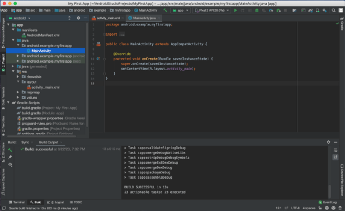
    Android Project File Structure (Source: Android Official Website)

    It’s obvious that the template doesn’t only use one folder that has everything. Instead, it has different folders with their respective jobs. For instance, your resource-related files should go to the res folder, while your code should go to the java folder. More important, when your app is complicated, you should have subdirectories within the java folder, for instance, you can have a folder for your data models, or you probably have a folder for views, and so on.

    I don’t think there is a one-size-fits-all solution, but you should develop your file structure with a meaningful organization and use it consistently, which is the key to improving your entire project’s readability and maintainability.

    Conclusions

    Again, it’s not simple to write readable code — it’s hard for beginners, and it’s also hard for seasoned programmers. In my opinion, it’s a lifelong learning process for every programmer to improve their code’s readability. I just shared the tips that I’ve learned from my ten-plus years of coding. Please feel free to share what you have for code readability so that we can all improve together.

    Thank you for reading this piece.
    下载开源日报APP:https://opensourcedaily.org/2579/
    加入我们:https://opensourcedaily.org/about/join/
    关注我们:https://opensourcedaily.org/about/love/

  • 开源日报第981期:《小插件 notifications-preview-github》

    16 12 月, 2020
    开源日报 每天推荐一个 GitHub 优质开源项目和一篇精选英文科技或编程文章原文,坚持阅读《开源日报》,保持每日学习的好习惯。
    今日推荐开源项目:《小插件 notifications-preview-github》
    今日推荐英文原文:《The Future of Data Science, Data Engineering, and Tech》

    今日推荐开源项目:《小插件 notifications-preview-github》传送门:项目链接
    推荐理由:一个网页扩展程序,能够预览 github 网页右上角的 notifications 消息,而不用跳转。
    今日推荐英文原文:《The Future of Data Science, Data Engineering, and Tech》作者:SeattleDataGuy
    原文链接:https://medium.com/better-programming/the-future-of-data-science-data-engineering-and-tech-7f0a503745fd
    推荐理由:本文摘录了共计6位来自科技界不同领域的人对2021年的期望和见解。即将结束的今年是不平凡的,过了这一年,信息技术又会往哪些方向发展呢?

    The Future of Data Science, Data Engineering, and Tech

    6 experts’ views on tech in 2021

    As 2020 comes to a close, we wanted to take a moment to reflect on all the changes in technology as well as look to see where things are going.

    Whether you are looking at startups and their IPOs, improvements in technology, or you paid attention to Amazon re:Invent, we saw a year filled with companies continuing to try to push boundaries.

    A personal favorite announcement from 2020 was AWS’s SageMaker Data Wrangler that is designed to speed up data preparation for machine learning and AI applications. This seems like a great move towards having more fluid machine learning pipelines that will hopefully further make machine learning more accessible to companies not focused on tech.

    But 2020 is ending, so we asked people from various parts of the tech world to provide their insights into what they were looking forward to in 2021 — whether that be new startups, technologies, or best practices.

    Let’s see what they had to say.

    1. Sam Cannon, Facebook, Data Scientist

    I feel like natural language processing (NLP) is currently moving at an unfathomable pace, which is simultaneously exciting and frustrating. Once I have established a decent pipeline for text classification or distributed word representation clustering, a new model comes out that outperforms what I was using yesterday.

    That being said, I am super excited about the direction that NLP is taking — particularly with respect to open source solutions for complicated NLP tasks. One of my favorite companies in this space, and my personal barometer of open source, state-of-the-art NLP, is Hugging Face. Hugging Face is following a creed of “solv[ing] NLP” through democratizing complex NLP models and tasks that would normally be impossible for many individuals to utilize due to the lack of computational power or expertise.

    They already offer simple sentiment analysis solutions that require minimal user input. Building on that, I think 2021 will usher in a wave of pre-packaged SOTA NLP models that can be used with one line of code. While it is impossible to forecast what will truly be accomplished in this space in 2021, I believe that, at the very least, out-of-the-box NLP models will allow more people to gain insights from their natural language data than ever before — and that is what I am most looking forward to in our field in 2021.

    2. Catherine Tao, The Data Standard, Data Scientist

    I am excited to see how cloud computing will be innovated in the tech space for 2021. As of now, the cloud is a space for a company’s data to be stored. There have been some challenges with this, such as scalability, efficiency, data streams, and more.

    I want to see how cloud computing can be improved in order to balance some of these major issues that tech businesses are facing. Many companies are struggling with how to bring AI into their businesses, and this results in certain companies falling behind in the tech industry. By innovating cloud computing, more companies should be able to implement artificial intelligence at their companies and deploy projects/products at a more productive level.

    3. Riley Kinser, Terrain, Head of Product

    Looking into 2021 (hopefully a much brighter year for commercial real estate!), my primary focus is to become an expert on both new and established tools for mapping geographic data. One of my primary roadmap objectives is to translate our insights at Terrain into maps that are easy to interpret for our end-users.

    A lot of the examples in the industry today are done using ArcGIS, which is an older but well-established tool for mapping data. I believe better tools may be out there, which presents an opportunity to provide our clients with a new take on an old classic. Two of the tools I’m interested in exploring are open source projects developed by Uber: H3 and kepler.gl. One of the main advantages to H3 that I see is the ability to subdivide the world into hexagons of varying sizes depending on zoom.

    This solves one of the early problems we identified, which is that different users like to take different perspectives on the boundaries of neighborhoods, submarkets, or cities within a metro area. This also better enables us to develop maps internationally where data around boundaries can be harder to obtain.

    kepler.gl, on the other hand, is interesting because of its relative ease to develop and host online for end-users or for an MVP. Uber developed Kepler.gl to allow users to internally (technical and non-technical) and quickly develop maps that could be shared for visualizing ideas from geospatial data. One of the other fun things that kepler.gl supports is the ability to easily visualize geographic data over a time series. I expect to begin with kepler.gl for our MVP and then explore H3 as we begin to collect user feedback.

    4. Chris Zeoli, Base10 Partners, Principal

    While there are a number of trends I am very excited about, eCommerce (particularly the rise of Shopify and the associated tools with it) and telemedicine are two of the areas I am most excited about. I’ve written about the Shopify ecosystem and the company continues to reach new heights, powering over $100B of GMV for over 2 million merchants.

    I am particularly excited about its new partnerships with the likes of Facebook/Instagram, TikTok, Alipay, Affirm, and Pinterest, as Shopify becomes the underlying infrastructure for commerce across the major networks where consumers are. Its software as well as third-party ecosystem have been incredibly exciting to watch flourish. It’s been interesting to see traditional areas of eCommerce continue to grow (apparel and fashion, CPG products, health and wellness, etc.) while seeing newer categories like food/ grocery to auto come online through platforms like Shopify.

    I’m also very excited by telehealth and new digital healthcare experiences. It’s clear with COVID that healthcare is front and center in terms of what is “essential” for our economy. At 20% of GDP (and growing), the category has had few breakout outcomes and no FAANG-scale companies yet. I would imagine that in five years, there will be at least one major player (and also expect to see Apple, Google, and Amazon continue to push into healthcare). 2020 was a big year for telehealth, with Teladoc acquiring Livongo and creating the most formidable brand in digital health yet at $30B+ combined enterprise value and over $1.5B of ARR growing >100%.

    I’m excited to see a whole new wave of digital health experiences that address the most essential human need in taking care of ourselves.

    5. Jun Kim, Facebook, Data Engineer

    The upcoming 2021 technology that excites me the most is the long-anticipated Apache Airflow 2.0 release. Ever since its initial release in 2015, Apache Airflow has been one of the most popular workflow management systems—if not the most popular — in data engineering.

    Its great success can be attributed to the fact that it allows workflows to be written as code, simple but yet effective GUI, and its general flexibility in structuring data pipelines. With the new 2.0 release, everyone’s favorite workflow management system will get even better. Airflow 2.0 will have many impressive added features, including fully supported and comprehensive REST API, TaskFlow API, and Task Groups. And it also offers many improvements that include simplified Kubernetes Executor, scheduler with low latency, and even more intuitive GUI.

    I am excited to try out the new and improved Airflow.

    6. Michael Mirandi, Saturn Cloud.io, Head of Strategy

    There are several technology trends that I’m excited to watch in 2021, but none more than the growing popularity of GPU computing in data science and machine learning. The shift is driven by performance first, as well as ease of use made possible through open source project RAPIDS. If you aren’t familiar with it, RAPIDS enables users to execute Python code on NVIDIA hardware (disclaimer: NVIDIA sponsors the project).

    The team released the results of the industry-standard Big Data Analytics Benchmarks earlier this year, where they outperformed by nearly 20x! It’s also interesting that these benchmarks demonstrate not only the power of GPU computing for data science workloads but also its ability to accelerate traditional data engineering ETL jobs. Will this lead to even wider adoption of Python? I’d be willing to bet on it, especially as a new crop of data science startups have recently released distributed GPU computing platforms — that is the ability to spin up a cluster of GPUs in the cloud for unprecedented speed.

    Tech in 2021 and Beyond

    There is a lot to look forward to in 2021, whether it be pre-packaged SOTA NLP models that can be used with one line of code, natural language queries, or improvements in frameworks like Airflow.

    Small and large technology companies seemed to have continued on, even with all the Zoom fatigue.

    We hope that 2021 will not only lead to technology improvements but will also be a year where we progress in areas that lifts everyone’s boats.

    Thanks for reading and good luck in the new year!


    下载开源日报APP:https://opensourcedaily.org/2579/
    加入我们:https://opensourcedaily.org/about/join/
    关注我们:https://opensourcedaily.org/about/love/

  • 开源日报第980期:《chinese-poetry》

    15 12 月, 2020
    开源日报 每天推荐一个 GitHub 优质开源项目和一篇精选英文科技或编程文章原文,坚持阅读《开源日报》,保持每日学习的好习惯。
    今日推荐开源项目:《chinese-poetry》
    今日推荐英文原文:《John Deere plans to send VR headsets with virtual tractor demos for CES 2021》

    今日推荐开源项目:《chinese-poetry》传送门:项目链接
    推荐理由:最全的中华古典文集数据库,包含 5.5 万首唐诗、26 万首宋诗、2.1 万首宋词和其他古典文集。诗人包括唐宋两朝近 1.4 万古诗人,和两宋时期 1.5 千古词人。数据来源于互联网。 古诗是中华民族乃至全世界的瑰宝,我们应该传承下去,虽然有古典文集,但大多数人并没有拥有这些书籍。从某种意义上来说,这些庞大的文集离我们是有一定距离的。而电子版方便拷贝,所以此开源数据库诞生了。此数据库通过 JSON 格式分发,可以让你很方便的开始你的研究。
    今日推荐英文原文:《John Deere plans to send VR headsets with virtual tractor demos for CES 2021》作者:Shara Tibken
    原文链接:https://www.cnet.com/news/john-deere-plans-to-send-vr-headsets-with-virtual-tractor-demos-for-ces-2021/
    推荐理由:John Deere 计划为 CES 2021 提供带有虚拟拖拉机演示的 VR 耳机。它可以将佩戴者运送到虚拟的农场, 一遍在播种季节观看产品。这款产品可以为媒体提供视觉效果, 并且可以给不熟悉农业的人提供简单的教程。

    John Deere plans to send VR headsets with virtual tractor demos for CES 2021

    As soon as I hit play, the shed doors bearing the words “John Deere” open to reveal a bright green tractor. As it rolls toward me, the tractor quickly swerves to reveal what it’s towing: a large planter with green arms and yellow buckets. (These are called row markers and seed boxes, respectively, my lifelong farmer father and eight-year-old, farmers-in-training nephews tell me). Soon the markers expand, showing me just how massive the machine really is.

    The video is a glimpse into a virtual reality demo the storied farm equipment maker is planning for CES 2021, which starts next month. John Deere plans to send VR headsets to reporters, with the goal of virtually transporting them to a farm to see the company’s products at work during planting season. Offering something visual for media is key for translating just how big Deere’s products are — and educating people who aren’t familiar with agriculture.

    “We want to take you from where you’re at and feel like you’re someplace totally different,” Jon Ebert, manager of John Deere’s public and industry relations team for North America, says in an interview.

    John Deere will distribute Facebook’s $299 Oculus Quest 2 goggles, which operate without a wired connection to a computer. Designing the VR experience, sending the devices to users and other associated costs were less than exhibiting at the Las Vegas Convention Center, Ebert said. John Deere’s budget for CES in 2021 is about 75% of its normal CES expense.

    CES is one of the biggest tech shows of the year and draws thousands of people from around the globe to Las Vegas, where they can see the newest innovations in tech. Last year’s event attracted 170,000 attendees and 4,400 exhibitors across more than 2.9 million square feet of exhibit space in 11 official venues.

    The coronavirus pandemic has forced CES to go all virtual this year. The conference will take place from Jan. 11 to 14, and expectations for the amount of news generated by the event have been scaled back compared to previous years. CES 2021 is unlikely to look anything like the gatherings held in earlier years.

    CES 2021 is the latest example of a hurdle that Deere and others in the tech industry face when it comes to events: Making people feel like they’re experiencing products in person. Interviews and briefings can be handled by video conferences, but demo rooms simply don’t translate to Zoom. For big conferences like CES, the convention center floor is a key part of the show. Attendees can walk from booth to booth, seeing the latest in tech and finding hidden gems among the hundreds of exhibitors. Without the serendipity that freedom-to-roam affords, smaller companies will find it hard to get noticed. And even big companies may discover it’s difficult to demonstrate what products are like if they can’t be seen in person.

    Companies are experimenting with virtual reality to fill the gap. At this year’s IFA — Europe’s biggest trade show held each summer in Berlin — Samsung and LG created virtual demo rooms. Samsung used Epic’s Unreal Engine for games to build a virtual, 3D tour experience, a choose-your-own adventure digital demo. LG launched a virtual exhibition that demonstrated its latest product lineups within a realistic rendering of Berlin Messe’s Hall 18, its usual IFA home.

    While participants generally liked the virtual rooms, the companies haven’t said if they’ll do something similar for CES.

    “There will be interactive mechanisms to ask questions, schedule meetings, these kinds of things,” says Steve Koenig, vice president of research for the Consumer Technology Association, the organization hosts CES. “At its heart, that’s what CES is really about, bringing industry together for conversations and leading to business or news stories or whatever it is.”

    John Deere’s tech push

    John Deere is relatively new to CES. The farming equipment company exhibited for the first time in 2019, an effort to introduce itself to a new crop of potential customers and media. While the company is best known for its big green tractors, it has also built operations in artificial intelligence and even purchased 5G airwaves to install next-generational cellular technology in its Iowa and Illinois factories.

    Deere’s technology push is all about precision agriculture. Farmers want to find out — nearly down to the individual plant — what’s happening with their crops during the planting process, the application of fertilizer and harvest. They want to know if a certain seed performs better than others or why a part of the field ended up with poor yields. Precision agriculture uses mapping satellites and other technology to let farmers know what’s going on in the soil, letting them be more efficient with gas, fertilizer and seeds.

    In the Midwest and other crop growing regions of the US, self-driving tractors are commonplace. (The farmer still sits behind the wheel.) Sensors can detect what the machine’s doing, what the crop conditions are and everything in between. Farmers can monitor the progress of planting and harvesting from their iPads, and tractors serve as their own mobile hotspots. It’s a specialized reflection of our own increasingly connected world, except farmers have used many of those technologies, like auto-steering and GPS mapping, since the ’90s.

    Deere wants people beyond farmers to know about the advances in agricultural technology. But don’t expect the announcement of a new tractor or AI system at CES. The presentation will be more about education than newly released products.

    “We’re using CES to make sure that we’re generating awareness of the technology that John Deere is envisioning to take this immense variability for farmers [and] make it more predictable,” Ebert says.

    At its first CES, the company focused on harvest. It displayed a combine, which collects corn and other crops from the field. Last year, it featured a sprayer, which applies chemicals to fields.

    This year’s focus is planting. “As we go through the VR experience, it will … show how technology is important in this step because this step helps make … the next job smarter,” Ebert says.

    Down to the seed level

    Viewing something in VR isn’t quite like experiencing it in person. But virtual reality has a big benefit over the real world: it can take you to places you can’t enter in reality. For John Deere, that’s farm soil.

    The company’s VR system will show the “journey of the seed,” Ebert says. While the tractor and planter weigh “upwards of 40,000 pounds,” they cause little disruption to the soil when planting seeds. Deere VR users will get to see that.

    “You’re never going to be in a soil pit … watching a planter go over the top of you,” he says. “But as we think about trying to highlight the different complex processes that are happening and the technologies that go into planting the seeds, this allows us to have a vantage point to see all of that come together.”

    Users won’t be driving around virtual tractors, playing games or going on any sort of choose-your-own-adventure with Deere’s systems, at least not in VR. Instead, the demonstration will feature guided hotspots inside the software that users navigate to to learn about Deere technologies. The company will have an interactive planting game on its website.

    “2020 has thrown curveballs … for everyone, and this has been an opportunity for us to take a look at how we can do things more unique,” Ebert says.

    After the planter booms expand, I’m quickly transported to what appears to be a hole in the ground. As I look up, a tractor speeds toward me, driving over me before I can react. Turns out I’m not a farmer in this part of Deere’s demo. I’m among the seeds, watching the planter and its companion connected technology do its job. And I’m really on my couch.
    下载开源日报APP:https://opensourcedaily.org/2579/
    加入我们:https://opensourcedaily.org/about/join/
    关注我们:https://opensourcedaily.org/about/love/

  • 开源日报第979期:《Java 工具 chimm.excel》

    14 12 月, 2020
    开源日报 每天推荐一个 GitHub 优质开源项目和一篇精选英文科技或编程文章原文,坚持阅读《开源日报》,保持每日学习的好习惯。
    今日推荐开源项目:《Java 工具 chimm.excel》
    今日推荐英文原文:《Do People Still Have Zoom Parties?》

    今日推荐开源项目:《Java 工具 chimm.excel》传送门:项目链接
    推荐理由:该项目是基于 Apache POI 和 Antlr4 打造的生成 excel 的 Java 工具。主要功能:通过在 excel 软件中编写模板,即可在 java 程序中对数据进行快速处理,减少了开发人员通过程序生成表格的工作量,提高了工作效率。
    今日推荐英文原文:《Do People Still Have Zoom Parties?》作者:Viola Altiste
    原文链接:https://medium.com/the-shadow/do-people-still-have-zoom-parties-d40b3ed6b7cb
    推荐理由:线上聚会肯定比面对面差远了啊。

    Do People Still Have Zoom Parties?

    A young millennial just misses her friends

    (Photo by Gabriel Benois on Unsplash)
    When the pandemic first hit in March 2020, I received an overwhelming amount of invites from friends near and far to have Zoom parties. At first, it was a really good opportunity to reconnect and “see” friends that I had not spoken to in years. These Zoom hangouts got me through those early days of the pandemic when I felt so lost after countless shutdowns and cancellations.

    As time went on, however, it was a nuisance to listen to people talk on a computer screen for hours on end. I had to attend several serious meetings on Zoom for work-related reasons. Additionally, I was taking an online course that required frequent Zoom sessions. I was so tired of being on Zoom all day that I couldn’t even bring myself to video call family members or friends for fun.

    Many regions introduced social bubbles as Covid cases declined over the summer. Essentially, you could form a bubble of up to ten people who do not need physical distance from one another. The idea is that you were only ever in close contact with these people.

    It is important to note that all members of your household are automatically part of your bubble so, in reality, it is difficult to make it truly ten people if you want to see multiple family members or groups of friends.

    The social bubble concept brought me back to my socially awkward high school self. Throughout this pandemic, I was in an incredibly fortunate position to have had my boyfriend in my bubble, but I missed the friend group dynamic.

    I would painfully scroll through countless social media posts of people reconnecting with their friends and family, wishing I could experience that joy. It was no different from my high school days where my classmates would attend countless social events while I sat on the sidelines wishing I could have something simple like a group of friends to sit with at lunch.

    When my online course finished, I took some much needed time away from Zoom meetings and resumed my video chats with my parents and out of town friends.

    However, I felt conflicted about how I should maintain a connection with my friends in my area. I wasn’t comfortable initiating an in-person hangout as my boyfriend had been meeting a few of his friends, which would have created a contact-tracing nightmare.

    It felt silly to consider a Zoom gathering as everyone was meeting in person again. Therefore, I had no choice but to watch everyone else have fun while I sit at home and do nothing, just like in high school.

    The second wave of Covid-19 finally made it to my isolated Canadian city a month ago. Social bubbles are paused so obviously, this must mean that people will get back into Zoom parties. Not so simple.

    My work colleagues and I did attempt to resume Zoom gatherings this fall. At first, people enjoyed catching up and hanging out just like old times. As we had more, they became increasingly poorly attended until we gave up altogether.

    I completely understand why people are no longer interested in virtual gatherings. Online meeting platforms have become a necessary evil in our lives, but no technology will ever replace in-person gatherings. We’re all so burnt out from our necessary online meetings that Zoom cocktail hour is just too much.

    I’m certainly not complaining about the restrictions, I am a huge advocate of staying home and not meeting with anyone outside your household. I continue to make huge personal sacrifices to protect myself and others.

    The lack of interest in online events during the second wave combined with the inability to meet in social bubbles has caused me to feel more disconnected than ever. In some ways, I was feeling more satisfied socially in March and April when Zoom hangouts were all the rage.

    Zoom parties are awkward, put simply. If there are ten people there, for example, all ten of us have to participate in the same conversation. If I’m feeling excluded from a conversation at an in-person party, I can walk over to someone else. When two people dominate the conversation on Zoom, we are all stuck listening to them until someone figures out how to change the subject.

    I still enjoy being at Zoom parties, even if I am mostly an observer. Seeing people on a computer screen is better than nothing at all.

    As time went on, I found I much preferred having video calls with specific people than attending large virtual gatherings. I would still scroll social media and see people having online group gatherings and wonder why I couldn’t be a part of that or have that in my life.

    I know you are probably thinking, “Wow, first world problems”. It’s true, I have been extremely privileged during this whole pandemic.

    Although I was not able to work as a musician during the pandemic, my orchestra fully paid all the musicians until the end of our contract. During the summer, I was eligible to collect the Canadian Emergency Response Benefit, which honestly was not a lot of money, but it kept me afloat financially for four months as I do not have children or other dependents to support.

    Technically, my boyfriend and I both live alone, so we were able to be a two-person bubble the whole pandemic and essentially have our trial move-in. Even though we had only been officially dating for one month when the pandemic began, we knew we needed to be there for each other to get through these crazy times.

    No amount of acknowledging my privileges will ease the sense of loneliness and isolation I feel, however. I miss the open-invite gatherings we had in the old days. Virtual hangouts, although better than nothing, cannot fully replicate a party.

    With promising news of a vaccine, it seems as though normal may be just around the corner. I choose to proceed with cautious optimism, however.

    As a professional musician, my industry has been hit quite harshly by lockdowns and restrictions. I am thankful that I was able to resume work this fall, but we are still subject to strict distancing protocols. I would love nothing more but to play with a large orchestra and sit close together without needing to wear masks, but we are a long way from that.

    Even with the vaccine, I’m preparing myself for the possibility of distancing and wearing masks for at least another year or two, if not longer. It will take time to get the vaccine widely distributed and then ensure that it is working.

    What does this mean for Zoom parties? Are people going to learn how to embrace online gatherings for the next few years or are we just never going to speak to those outside our household until Covid is eradicated?

    As a 26-year-old, I am transitioning out of young adulthood, so not seeing my friends isn’t as much of a tragedy as I make it sound. I am in a committed relationship and having my boyfriend in my life means way more to me than being invited to some Zoom hangout or social bubble.

    However, I still feel young and enjoy socializing with friend groups in a similar way to my university years. I didn’t want to become that person who only cares about their partner and never has time for friends anymore, but it’s hard to see anyone outside your household in a pandemic.

    I continue to tell myself that everyone has their own battles in the pandemic. There’s no need to cause drama or take it personally if people aren’t interested in meeting on Zoom or in person.

    One day, possibly within the next year, we can resume social gatherings. Until then, we must have patience and kindness with our friends. For now, we Zoom and embrace its awkwardness.


    下载开源日报APP:https://opensourcedaily.org/2579/
    加入我们:https://opensourcedaily.org/about/join/
    关注我们:https://opensourcedaily.org/about/love/

←上一页
1 … 13 14 15 16 17 … 262
下一页→

Proudly powered by WordPress