• 开源镜像
  • 开源沙龙
  • 媛宝
  • 猿帅
  • 注册
  • 登录
  • 息壤开源生活方式平台
  • 加入我们

开源日报

  • 开源日报第990期:《影子输入法》

    25 12 月, 2020
    开源日报 每天推荐一个 GitHub 优质开源项目和一篇精选英文科技或编程文章原文,坚持阅读《开源日报》,保持每日学习的好习惯。
    今日推荐开源项目:《影子输入法》
    今日推荐英文原文:《Where Does Our Data Go When We Die?》

    今日推荐开源项目:《影子输入法》传送门:项目链接
    推荐理由:影子输入法是一款开源、绿色、安全的输入法。在高度自定义输入法,管理词库数据库的基础上,加入了魔法字符串和超级命令等功能,提高输入效率。
    今日推荐英文原文:《Where Does Our Data Go When We Die?》作者:Lance Ulanoff
    原文链接:https://medium.com/@LanceUlanoff/where-does-our-data-go-when-we-die-fb914cf2bd92
    推荐理由:未来我们会将墓志铭写在博客上吗?

    Where Does Our Data Go When We Die?

    A new book on our Digital Afterlife has me freaking out about my own digital legacy

    I don’t know what happens to us after we die. It’s a universal question that, while some claim to know what happens, no one can definitively answer. I do know, though, that the closest thing we have to a digital soul, our sprawling corpus of data across social networks, email, ecommerce activities, streaming habits, mountains of digital photos and videos, browser history, location data and more will outlive us and, like a binary ghost, continue to interact with the living.

    Perhaps no book paints a clearer picture of this reality and the uncomfortable dilemma most of us face than Digital legacy: Take Control of Your Online Afterlife, by Daniel Sieberg and Rikard Steiber. The two co-founded GoodTrust, a company devoted to, you guessed it, helping the living secure their digital legacy for, I guess, eternity. So, yes, the tome is self-serving, but Sieberg and I have known each other for almost two decades and I know he, as a former journalist, approaches topics with an inquisitor’s eye.

    We met in the ought’s at CES where Sieberg was covering technology and innovation for CNN. He was very good, and we collaborated on numerous entertaining segments (I liked to find cool products and he let me explain and demonstrate them on air). Sieberg later worked for CBS before joining Google as a sort of a media liaison (and more). Now he splits his time between serving as VP of Technology for Huawei and GoodTrust.

    My point is, I know that Sieberg, who previously wrote The Digital Diet, a prescient book about how to take a break from our social media, email and online obsession, approaches topics like death and data seriously.
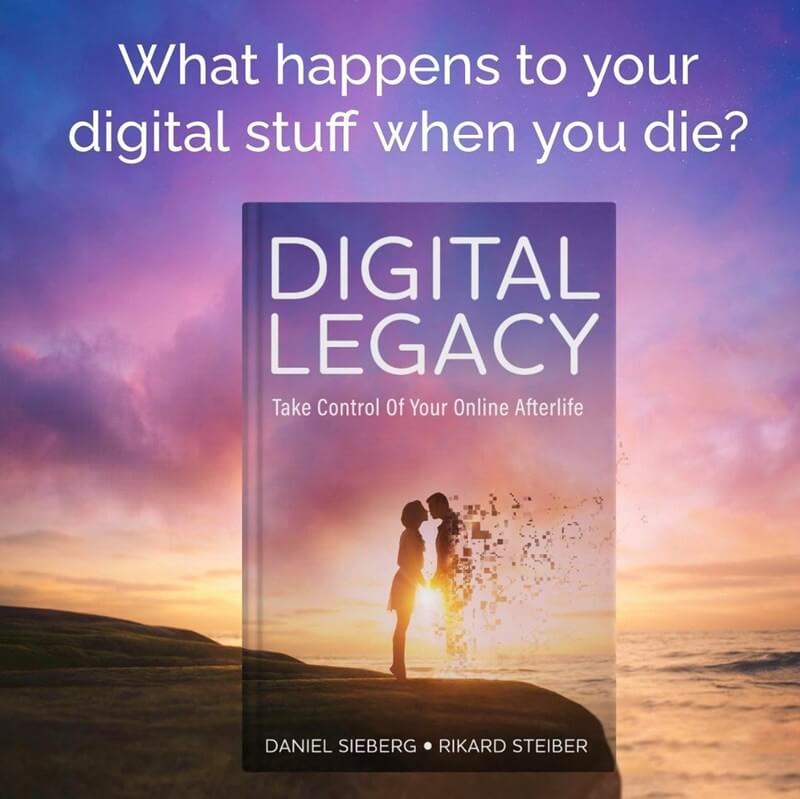
    (Sieberg’s and Steiber’s new book)
    As I was reading the pithy, but thorough book, which looks at how we got here and dives deep into the questions of how to handle your digital legacy and take concrete steps to preserve it (or delete it with impunity), I realized that I’m not even remotely prepared to handle what happens to my own accounts.

    One night, I started discussing this with my family at the dinner table. We made jokes, because talking about death is so uncomfortable, but all quickly agreed that none of us are prepared. Yes, my wife and I do small things like share key passwords in LastPass so we both have access to our bank accounts. Still, we know it’s not nearly enough.

    We’re not alone in this. Sieberg’s and Steiber’s book lists 12 reasons why we’re not acting. The fact that it’s overwhelming resonated with me. I have often thought about dealing with my data in the abstract, but as soon as I start to take inventory of every digital trail I’ve walked or leave behind, I get crushed by the enormity of the problem. I also get that it feels narcissistic to worry this much, for instance, about my Twitter account. Does anyone really care about the hundreds of thousands of tweets I’ve posted over the last 13 years?

    However, maybe it’s enough that I do and there is something else about content like Twitter posts. Assuming Twitter and other platforms survive beyond me, those tweets, my Instagram Photos, my Facebook posts, and even what I write here on Medium, will not only outlive me, it will also have a digital afterlife that could impact my family and descendants.

    Digital Legacy notes that there will soon be more dead Facebook users than living ones, a factoid I reread a few times as I considered this Facebook Zombie army. I’m sure I’m not alone in getting reminders to celebrate birthdays of dead relatives. This is upsetting, though not necessarily the fault of Facebook since they do offer services for memorializing Facebook accounts.

    That’s another key point of the book. The digital sphere has gotten much better about dealing with death, but these tools only work if you take action, either by doing something now or at least giving your relatives the power to do something in your absence.

    Reading the book also reminded me how digitally I may in some ways appear more complete than I am in real life. I’ve scattered my interests and activities across a dizzying number of services (even the occasional TikTok). In words, photos, videos, browser searches, tweets, Facebook posts, Instagram stories and more, paint a world view of “Lance Ulanoff,” and one that may lead people to believe they know me. Yet, I wonder if this is how I want to be known, and remembered, when I’m gone.

    Over the years, I’ve had to write various mini biographies of myself to post on sites like LinkedIn, Mashable and PCMag. They are, I think, how I want to be known and represented outside my family. They don’t entirely sync with this sprawling digital me that I keep building on haphazardly like one of those shanty town villages.

    No one knows me like my family, but if I don’t deal with my own digital real estate, it will fall to them to try and untangle it and whatever questions they have about what they’ll find will go unanswered.

    I don’t expect to die anytime soon (most of us don’t), but life, especially during a Pandemic, is unpredictable. Putting off managing my digital legacy is only going to deepen the problem.

    The book talks a bit about trust, and it occurred to me that I’ve put enormous trust in Facebook Twitter, Google, Amazon, LinkedIn, and others to manage all this information. My wife and children will care when I die and actively try to manage my affairs. But what will any of these companies do? I mean proactively. Most may not realize I’ve died. Some, like Google or Facebook, could lock my accounts or even start deleting content if they see a prolonged period of inactivity.

    That sounds terrible, but if you didn’t expect your local Safeway supermarket to care that you’re gone, why should you think Amazon is going to do something about it?

    Digital Legacy suggests making digital assets lists, which is a good and smart idea, though it will certainly lead to feeling like you’re standing at the base of Mount Everest, knowing that you have to somehow reach the summit. It also suggests culling your data. This is tough for me because I never throw anything out, especially digital content, because, in my head, it takes up no space at all. Why should I delete that GIF from 1996?

    If nothing else, maybe the book will spur you (and I hope me) to officially entrust someone with your digital legacy, to have that tough conversation with your partner or parents about what to do with their Facebook account.

    If I’m being honest, reading the book made me uncomfortable. No one likes to spend that much time thinking about death, but it also put a bug in my ear, a little voice that keeps whispering, “ Secure your digital legacy before someone else simply snuffs it out.”


    下载开源日报APP:https://opensourcedaily.org/2579/
    加入我们:https://opensourcedaily.org/about/join/
    关注我们:https://opensourcedaily.org/about/love/

  • 开源日报第989期:《elasticsearch》

    24 12 月, 2020
    开源日报 每天推荐一个 GitHub 优质开源项目和一篇精选英文科技或编程文章原文,坚持阅读《开源日报》,保持每日学习的好习惯。
    今日推荐开源项目:《elasticsearch》
    今日推荐英文原文:《Biden’s @POTUS Twitter account won’t inherit Trump’s followers》

    今日推荐开源项目:《elasticsearch》传送门:项目链接
    推荐理由:Elasticsearch 是一个分布式的 RESTful 风格的搜索和数据分析引擎,能够解决越来越多的用例。作为 Elastic Stack 的核心,它集中存储您的数据,帮助您发现意料之中以及意料之外的情况。Elasticsearch 是一个实时的分布式搜索分析引擎, 它能让你以一个之前从未有过的速度和规模,去探索你的数据。它被用作全文检索、结构化搜索、分析以及这三个功能的组合。
    今日推荐英文原文:《Biden’s @POTUS Twitter account won’t inherit Trump’s followers》作者:Andrew Gebhart, Queenie Wong
    原文链接:https://www.cnet.com/news/solarwinds-hack-hits-major-tech-companies-and-hospital-system-what-you-need-to-know/
    推荐理由:2020年总统大选落幕, 现在正在进行一些交接工作, 其中就有社交平台方面的交接. 据报道, 拜登的@potus 推特账户不会自动继承之前的特朗普的followers, 这和17年特朗普政府上台恰恰相反.

    Biden’s @POTUS Twitter account won’t inherit Trump’s followers

    The @POTUS account on Twitter currently has 33 million followers. On Jan. 20, Inauguration Day, that number might drop. President-elect Joe Biden won’t automatically inherit the followers of the previous administration when he officially takes control of the account on the popular social media platform, Twitter said Tuesday.

    The company will also transfer the @WhiteHouse, @VP, @FLOTUS, @PressSec, @Cabinet, and @LaCasaBlanca to the Biden administration on Inauguration Day.

    “The accounts will not automatically retain their existing followers. Instead, Twitter will notify followers of these accounts to provide context that the content will be archived and allow them the choice to follow the Biden administration’s new accounts,” Twitter said in a statement. “For example, people who follow @WhiteHouse will be notified that the account has been archived as @WhiteHouse45 and given the option to follow the new @WhiteHouse account.”

    That’s a reversal of what happened in 2017, when Donald Trump’s incoming administration inherited the @POTUS account from President Barack Obama, complete with millions of followers. Twitter confirmed last month that Biden will get the rights to the handle @POTUS, which stands for president of the United States, whether or not Trump concedes by Jan. 20.

    Social media is a way for people, including the president, to instantly broadcast a message to a large number of people online. Twitter’s decision to not automatically transfer followers could limit the number of people the upcoming administration will be able to reach online. Biden’s team isn’t happy with Twitter’s choice.

    Rob Flaherty, the digital director for Biden’s presidential campaign, said in a tweet Tuesday that Twitter told Biden’s transition team that “as of right now the Biden administration will have to start from zero” when the @POTUS and @WhiteHouse accounts are transferred. In another tweet, Flaherty said Biden’s team pushed back against the idea but was “told this was unequivocal.”

    The Wall Street Journal, citing people familiar with the matter, also reported the issue was a “sticking point” that arose in a meeting last week. During the 2017 transfer of the White House Twitter accounts, there were some hiccups in the process, including technical glitches and complaints from users, according to the report.

    Biden’s transition team didn’t immediately respond to a request for comment.
    下载开源日报APP:https://opensourcedaily.org/2579/
    加入我们:https://opensourcedaily.org/about/join/
    关注我们:https://opensourcedaily.org/about/love/

  • 开源日报第988期:《元素字符串 smilesDrawer》

    23 12 月, 2020
    开源日报 每天推荐一个 GitHub 优质开源项目和一篇精选英文科技或编程文章原文,坚持阅读《开源日报》,保持每日学习的好习惯。
    今日推荐开源项目:《元素字符串 smilesDrawer》
    今日推荐英文原文:《10 Game Jam Strategies》

    今日推荐开源项目:《元素字符串 smilesDrawer》传送门:项目链接
    推荐理由:学过化学的话都知道化学里的分子结构简直就是各种各样,想要给他们每一个都单独画一张图得画到猴年马月。这个 JS 项目则与使用字符串来描述分子结构有关,项目提供了解析字符串并且画出对应图形的功能,动态生成可比每个分子画一张图存下来方便多了。
    今日推荐英文原文:《10 Game Jam Strategies》作者:Christian Behler
    原文链接:https://medium.com/better-programming/10-game-jam-strategies-92c88c81f834
    推荐理由:制作游戏的十个步骤,而你只有两天时间

    10 Game Jam Strategies

    What if you had 48 hours to build a video game?

    Game development is a lot of fun. But finishing a game is extremely time consuming and difficult. This is why game jams like Ludum Dare are great.

    When you only have 48 hours to create a game completely from scratch, you will actually finish a game and it feels very rewarding.

    You go through the complete process from the idea through the implementation to the final product, including all aspects of game development like coding, graphics, art, sounds, balancing, polishing, and more.

    I haven’t finished a real game yet. But I have finished all of my eight Ludum Dare entries. Here are some tips and strategies for participating in a game jam that have helped me place 18th of 630 in the last Ludum Dare.

    1. Sleep

    When you participate in a game jam like Ludum Dare that only takes 48 hours, you may feel tempted to work through the night and sleep very little or not sleep at all.

    Don’t do it!

    Sleep is important. You need to be well-rested to do good work. Working through the night while fighting tiredness won’t result in a lot of progress anyway.

    Also, try to stick to your normal daily routine. Eat regular meals, take breaks, and go outside to get some fresh air. Fewer hours of concentrated work are better than more hours of unfocused distractions.

    2. Idea

    Think about your game idea before the event starts. Some game jams announce their theme early, which gives you time to create a fleshed-out plan. Others, like Ludum Dare, only announce the theme when the event starts.

    Even without knowing the theme, you can start to think about some ideas beforehand. Maybe you want to create a platformer? A strategy game? Or is there a new design pattern you want to experiment with?

    Most of the time you can come up with a rough idea early and then adapt it to the theme when it is announced. If you only start to gather ideas when the event is already started, you lose valuable time.

    3. Plan

    Even when you have gathered a few good ideas before the event starts, you should take some time at the beginning of the event to fine-tune your idea to the theme and create a plan. Not just in your head. Write it down on a piece of paper or use your task scheduling program of choice.

    The plan should include all major game mechanics and the most important graphic and sound assets you will need. Try to think about the order of the tasks as well to make sure you do them in a sensible order. This will give you a rough structure to follow for the event.

    However, when you are a few hours in and the plan doesn’t work out or you have new ideas, just change the plan. There is no boss or customer forcing you to stick to the original idea. When you have a better one, just go for it.

    4. Scope

    One of the trickiest challenges in a game jam is the scope. How do you choose an idea that you can reasonably finish within 48 hours? It ultimately comes down to your abilities and experience.

    For your first game jam, choose the simplest game idea you can imagine, one that you know for certain you can finish within the given time. In my first Ludum Dare, I literally made Snake. When you finish early, you can always add more features. But because of the deadline, you cannot finish late, and submitting a half-finished game isn’t great.

    5. Time Management

    When you only have 48 hours to make a game completely from scratch, time management is the most essential challenge. As mentioned above, you should always prioritize sleeping, eating, and going outside. But that still leaves you ten to 12 hours per day to work on your game. What’s the best way to distribute your hours?

    If you have never created a game before, you may think programming takes up the majority of the time; it is called game development after all. However, even for small game jam games, programming takes up less than 50% of your time, and it’s a lot less than that for big AAA games.

    For a two-day event like Ludum Dare, my goal is to have a playable game before the end of the first day. That includes all major game mechanics and at least programmer art for everything. And because you are probably not going to produce extremely detailed and high-quality art assets for Ludum Dare games, that programmer art may already be the final version.

    That leaves the second day for all the other miscellaneous tasks, like sound effects, music, instructions, balancing, and polishing, which add up quickly and take up a lot of time.

    6. Music and Sound Effects

    Music and sound effects are very important for the overall quality of your game. They have their own judging category in Ludum Dare, but they are much more important than that. They affect the overall impression of your game. Music and sounds convey a lot of emotion and atmosphere.

    You don’t need to be the next Mozart to create nice music for your game; I certainly am not. There are many procedural music generators like Wolfram Tones that can be used even in the stricter Compo rules of Ludum Dare. With some experimenting, you can create nice background tracks within a few minutes.

    And the same thing goes for sound effects. With bfxr or jfxr (a JavaScript port of bfxr) you can easily create procedural sound effects, which are OK for many situations but have some limitations. However, your mouth has no limits, so when you cannot create a procedural sound effect, just make weird sounds into your microphone and add a few filters in Audacity. It works surprisingly well.

    7. Instructions/Tutorials

    Towards the end of the event, when you have implemented all the mechanics and finalized the graphics, make an effort to create the best instructions you possibly can. It doesn’t matter if you have made the perfect game if nobody understands how to play it.

    The best way to teach the player your mechanics is an interactive tutorial that introduces your mechanics one by one and lets the player try them out before continuing. However, an interactive tutorial takes a decent amount of time to make, time you may not have left to spare in the final push.

    Another good alternative is a pop-up tutorial. When the game starts, show one or two screens that list the controls and explain the mechanics, ideally with screenshots next to them.

    Always try to include the instructions in the game itself. Many participants only have the instructions on the website of the event, and it isn’t very convenient when you have to tab away to check the instructions or read a multipage novel before starting. Just add a few sentences of flavor text and a short list of the instructions on the website, but there should always be instructions within the game.

    8. Balancing

    Balancing, the bane of every game developer’s existence. Depending on the game this may be more or less difficult, but every game requires at least some of it.

    You need to get the difficulty just right so the game is challenging for the player while also possible to beat within ten minutes or so. And in a big game jam like Ludum Dare, there are players of all skill levels participating: Some may be platforming gods, while others fail to jump over the smallest gap. Just because of the skill gap between the players alone, it’s almost impossible to find a good balance.

    You also spent the past 48 hours creating and extensively playtesting your game, so you probably became pretty good at it, which makes it really difficult for you to judge how a new player would fare in your game. If you have time left and — much harder to come by as a game-developing nerd — friends, you should let them try an early version of your game, observe how they do, and ask for their feedback.

    9. Polishing

    Adding more exciting features to a game is fun, a lot more fun than polishing your game. But when the event is getting closer to the end, you have to prioritize polishing anyway.

    Play through your game multiple times and write down all of the little things that are rough, behave inconsistently, or are missing quality-of-life improvements.

    It’s the little fixes that will make your game shine. A simple hover effect here, a small animation, additional instructions, more information, a second sound effect for something that happens very often. The list goes on.

    There is a saying in game development that certainly holds true in game jams:

    “An average idea done well is better than a great idea done poorly.”

    And that’s what polishing is for. At some point, you have to be content with your idea. It probably wasn’t a completely novel idea that will change the industry forever. And that’s okay. Just take your average idea and make it shine.

    10. Code Quality

    Even in a two-day game jam where you rush to get everything done in time, you should try to focus on good code quality, even though it’s impossible to maintain for the whole event. At some point, you just want to hack something in there quick and dirty, and that’s fine. But in the beginning, you should try to write good code.

    The longer you can maintain good quality, the easier it will be to add and change things later. It has happened to me many times that I didn’t implement something properly in the early stages only to realize that I needed that particular functionality later on. So you might as well train good habits and do your due diligence. It probably only takes a minute early on, but it might save 15 minutes later. Also, some game jams like the Ludum Dare Compo require you to share your source code, so it’s always nice to keep it clean.

    Game jams are an awesome way to test your game development skills. Within a limited amount of time, you go through the whole process of making a game, all the way from the idea to the finished and published product.

    There is no universal best way to create a game jam game. These are some steps I am using in Ludum Dare events, and some of them may be helpful to you. But as always, the best tip is this: Just try it yourself. Start with a very simple idea, and you will realize that even finishing a small and simple game is a very rewarding achievement. And after a few events, you will find the steps that work best for you.

    The nice thing about game jams is that the placement doesn’t really matter. Some of your ideas will work out better than others, and you may rank higher or lower. But what it’s really all about is having other people play your game and leave feedback in the comments that you can learn and improve from.
    下载开源日报APP:https://opensourcedaily.org/2579/
    加入我们:https://opensourcedaily.org/about/join/
    关注我们:https://opensourcedaily.org/about/love/

  • 开源日报第987期:《线稿 ArtLine》

    22 12 月, 2020
    开源日报 每天推荐一个 GitHub 优质开源项目和一篇精选英文科技或编程文章原文,坚持阅读《开源日报》,保持每日学习的好习惯。
    今日推荐开源项目:《线稿 ArtLine》
    今日推荐英文原文:《Passion Isn’t Something You Find — It’s Something You Earn》

    今日推荐开源项目:《线稿 ArtLine》传送门:项目链接
    推荐理由:该项目能将照片转换成线稿,有独特的艺术效果;同时还能将线稿卡通化,该功能尚在制作中。
    今日推荐英文原文:《Passion Isn’t Something You Find — It’s Something You Earn》作者:Daniela Singlel
    原文链接:https://medium.com/the-post-grad-survival-guide/in-defense-of-not-turning-our-hobbies-into-side-hustles-92eecbf36fa5
    推荐理由:生存之外的兴趣很重要,所以多试试吧,如果这个要求不是太奢侈。

    Passion Isn’t Something You Find — It’s Something You Earn

    You’re not going to wake up one day and know what you want to for the rest of your life.

    I’ve wanted to play the guitar for a few years now, but I never made the time to pick it up and learn. I didn’t want to play it that bad. Recently, I decided I finally, genuinely wanted to play, so I invested in an online guitar course and started practicing for an hour every day.

    What am I getting at? Two months ago I didn’t have a passion for playing the guitar. Now I feel that familiar spark of excitement I get when I write.

    What changed? How did I go from not making time to play to loving it so much I invest an hour of my time daily? Easy.

    I started playing the guitar.

    Almost all twenty-somethings are seeking one thing: a passion.

    But that’s the problem — they’re just looking. They’re peering through a pair of binoculars as if their passion is going to jump out at them like Waldo and his red-and-white sweater. But sitting at your window isn’t going to do anything.

    You’re not going to wake up one day and have the answers you’re searching for. As great as it would be for our dreams to solve our problems, if you think about it, our dreams don’t always make that much sense anyway. So what can you do?

    You come back to reality and you get shit done.

    Let’s talk about it some more with a story from Wolverine himself.

    In an interview on The Tim Ferris Show, Hugh Jackman shared that he went to college to get a degree in journalism. However, for his final semester of college, he still had to take an elective. His friend recommended the theater class because it was easy. “There’s no exam, there’s no play, and you pass,” his friend told him. So, Jackman took the class.

    But for the first time ever, the theater professor decided he was going to do a play, and by ballot, Jackman ended up getting the lead role. By the end of the semester, three weeks before graduation Jackman realized he’d had a lot of fun. “Oops. I think I turned right and I was meant to turn left,” he said. So, he graduated with a journalism degree but started pursuing acting.

    Hugh Jackman didn’t wake up one morning and realize he wanted to be an actor. He didn’t have an interest in acting. He took a class because it was easy, and it ended up changing his life.

    It was only after he started acting that he became passionate about acting.

    Passion isn’t something you find. It’s something you earn.

    With weeks, months, and years of studying and work. It’s a gift. A chance for you to love something so much you’re willing to work at it, succeed at it, and be joyful while you work on it.

    If you want to find your passion, you need to keep your eyes peeled and your heart open, but most importantly, you need to go out into the world and try things. Actually, you don’t even need to do that. You can go online and discover. You can read books.

    When I graduated from high school, I started a blog because I had no interest in other matters. I just knew I wanted to build an online business. So, I wrote, and I wrote, and I wrote, and I felt… nothing. Then, in 2019 — three years later — I started writing on Medium, began taking it more seriously, and I realized Holy shit, I’m a writer.

    It went the same way with fiction. I wrote fanfiction for a while not because I wanted to be a fiction writer, but because it looked fun. It was only a year later that I realized I wanted to write books.

    I wouldn’t have realized I loved writing until I started writing.

    You just have to start with something you’re even a little bit interested in.

    If you’ve ever thought about what it’s like to write a song, vlog, or write a short story, give it a try. Look up some classes online, or watch a couple of YouTube videos. You don’t need to think about it as a potential career — just let your interest and curiosity lead you.

    Don’t put pressure or expectations on the new things you try. That kills joy. Do them with an open heart and pure excitement, just like a toddler does literally everything.

    If you like it, keep it going. It’s that simple. Don’t worry about whether it gets you out of bed in the morning or that it keeps you up at night. Forget all that talk you hear about flow and getting in the zone.

    Liking it is enough. Liking it will eventually lead to love and passion. Because remember, passion is gifted later. Not at the start.

    Just because you love something doesn’t mean you want to make a living off of it. How do you differentiate the two?

    I played the violin for four years. I loved it deeply. I worked hard at it, at becoming the best in my high school orchestra, and because of the work I put in, I grew quickly. But by the time I was about to graduate, I had to ask:
    + Did I want to play professionally? + Did I want to go to college and master it? + Was I willing to spend hours practicing every day?
    I thought about it for a few days before realizing I didn’t want that. I loved playing the violin, but I loved it out of innocent joy and pure freedom.

    You can ask those same questions as you pick up hobbies and study new things, such as playing instruments, reading history books, or taking a marketing class.
    + Are you willing to work at it? + Will you stick around for at least three to five years? + Do you want to keep studying and growing? + Does thinking about your future in it bring you joy?
    As I said, you won’t wake up one day and know what to do with the rest of your life. Start doing something about the random things that capture your attention and set out to discover if you want to do it for a long time.

    Once you’ve answered yes to those questions, you’ve hit the goddamn lottery. If you haven’t, keep trying. You’re not losing anything, anyway. You’re living.


    下载开源日报APP:https://opensourcedaily.org/2579/
    加入我们:https://opensourcedaily.org/about/join/
    关注我们:https://opensourcedaily.org/about/love/
←上一页
1 … 11 12 13 14 15 … 262
下一页→

Proudly powered by WordPress