• 开源镜像
  • 开源沙龙
  • 媛宝
  • 猿帅
  • 注册
  • 登录
  • 息壤开源生活方式平台
  • 加入我们

开源日报

  • 开源日报第599期:《凑字数 BullshitGenerator》

    4 11 月, 2019
    开源日报 每天推荐一个 GitHub 优质开源项目和一篇精选英文科技或编程文章原文,坚持阅读《开源日报》,保持每日学习的好习惯。
    今日推荐开源项目:《凑字数 BullshitGenerator》
    今日推荐英文原文:《Finding Programming Boring? Here Are 5 Ways to Make It Enjoyable》

    今日推荐开源项目:《凑字数 BullshitGenerator》传送门:GitHub链接
    推荐理由:小学的时候我们就为了作文写够字数学会了各种凑字数的方法,那个下面写着 600 的格子仿佛是我们所追随的却又永远到不了的地平线一般。这个项目就将凑字数发挥到了极致,各种重复用词名人名言等等将页面写的满满当当——但是实际上一点意思都没有讲,只是单纯的摆出了准备讲的架势而已,不过这样凑字数大概会被老师叫去办公室的还是仅供娱乐比较安全……
    今日推荐英文原文:《Finding Programming Boring? Here Are 5 Ways to Make It Enjoyable》作者:Dler Ari
    原文链接:https://medium.com/better-programming/finding-programming-boring-here-are-5-ways-to-make-it-enjoyable-80881a7cb598
    推荐理由:在不够高扬的时候提高编码工作效率

    Finding Programming Boring? Here Are 5 Ways to Make It Enjoyable

    Let’s face it: While programming is usually fun, sometimes it can get really boring. Sometimes you just hit the wall, forget the underlying purpose, and eventually burn out.

    You can end up with days or weeks of not programming — doing everything except sitting in front of the computer. If programming is your main source of income, then these off days can become overwhelming and eventually lead to giving up programming.

    So the question is: How do you keep yourself productive and active in programming? How do you make the journey enjoyable during those times when you’re finding it difficult?

    I’ve had moments where I just wanted to give up, questioned if it is the right path to take, evaluated other job fields, and so forth. Personally, I’m the type of guy that finds it difficult to sit down in front of the computer for hours.

    Here are some of my secret ingredients to make programming fun again if you ever enter a state of boredom. This is not an universal law — just the things that have worked for me so far. However, there are a few things you can still take with you from this article.

    Here’s what we’ll address:
    • Music is underrated
    • Too many things to do
    • “I can do this” mindset
    • The art of learning
    • Take breaks regularly

    Music Is Underrated

    Programming is a psychological sport. Even though you don’t jog or lift weights, the thinking process of solving problems drains your energy.

    In addition, you go through many emotions — emotions that feel good like when you manage to solve something or emotions of stress and anger because you can’t find the solution. The majority of programmers face all of this.

    A great way to handle these emotions is to listen to good music — not any type, of course, but the ones that get you excited and help you think properly. For me, I like listening to old-school music from the ’80s and ’90s. Music is one of the few things in the world that can change someone’s mood within seconds. Listen to something that makes you happy and brings up good memories.

    Tip: Listen to music that helps you think, with few beats and vocals, in order to help you concentrate for longer periods. Too much noise will just make you tired quicker.

    Here are a couple of playlists on Spotify I listen to: Anjundeeep New Releases, Night Rider, Synthawave from Space, Chill Tracks, and Downtempo Beats.

    Too Many Things to Do

    You start to panic thinking of all the things you need to implement. And before you know it, you’ve done nothing but overthink.

    Let me begin by saying this is fully normal. A construction worker has the same problem — as do most jobs out there.

    When these thoughts enter your mind, don’t follow the emotions. Instead, use a simple trick: Focus on the thing you currently work with (if it gets complicated, make some drawings). Sometimes the issue is that we have too much in our head and too little on a paper. A simple pen and paper helps to map things into perspective by clearing your head. Another thing is to simply take a short 15-minute nap.

    Tip: If you have too many things to do, begin to prioritize what’s important and what’s not. Ask yourself this: Do I really need to know this? If yes, then what value does it provide?

    “I Can Do This” Mindset

    This type of mindset “is a good thing to have in terms of taking responsibility toward solving problems.

    However, you must realize you can never learn something fully — there is always room for improvement. Asking questions is a great way of getting insight and ideas, especially if you work in an organization. The ones I’ve seen doing great in companies are those that ask questions — questions that are well formulated.

    What you gain from reading articles or watching videos is great, but what you gain from asking is unique knowledge based on experience. Programming is a job, and it’s about sharing and helping each other out. Together we reach goals much faster.

    Tip: When asking a question, make sure you understand the problem. Building knowledge on top of existing knowledge makes it easier to learn stuff. But don’t let this stop you from asking — sometimes we know nothing, and that is fine.

    The Art of Learning

    There’s a saying: When you truly learn something, you realize how much you don’t know.

    Learning is a process that depends on time through consistent discipline. We live in a era where we think just because we watch some online videos, read articles, or listen to talks we get smarter.

    But unfortunately that’s not the case. Knowledge is built upon using what you’ve learned and putting it into practice. Want to learn how to use React, Angular, or whatever framework? Build something simple.

    Take Breaks Regularly

    In my early days of programming, I had this understanding that programming was about locking yourself inside a dark room and coding all day. Similar to what we see on movies these days. However, I gradually realized that programming requires taking breaks, similar to what athletes do in most sport activities like boxing, soccer, basketball, and so on.

    Think of the brain as a car engine. And what does an engine need? It needs oil and petrol to operate right? For you, that means you need to eat healthy food, drink water, and take breaks in order to perform a good job. Resting the mind leads to creative thinking, and creative thinking leads to better problem solving.

    Tip: Make sure you get enough sleep. This is a critical factor most programmers overlook.

    Summary

    In general, programming is a job or a hobby that can be boring sometimes. I’m not gonna lie and say it’s all fun. It can drain your energy and motivation for a lot of things in life.

    But it doesn’t have to be this way. In most cases, it’s not about the code or the challenging problems but the mindset toward it.

    So listen to what you really want — sometimes we just need a short break, or sometimes we just need help from someone. Don’t hesitate to ask.

    My way of seeing life (personal tip)

    In any situation, I would say don’t take things too personal or seriously in life. Enjoy the process and the things you learn.

    If there is a problem you can’t solve, don’t stress. Realize that there is always a solution out there that depends on time and consistency.

    Last but not least, remember to spend time with the ones you love, especially your parents, because we never know what the future holds.
    下载开源日报APP:https://opensourcedaily.org/2579/
    加入我们:https://opensourcedaily.org/about/join/
    关注我们:https://opensourcedaily.org/about/love/
  • 开源日报第598期:《猫元素充满 lovely-cat》

    3 11 月, 2019
    开源日报 每天推荐一个 GitHub 优质开源项目和一篇精选英文科技或编程文章原文,坚持阅读《开源日报》,保持每日学习的好习惯。
    今日推荐开源项目:《猫元素充满 lovely-cat》
    今日推荐英文原文:《10 Motivators That Are Not Money》

    今日推荐开源项目:《猫元素充满 lovely-cat》传送门:GitHub链接
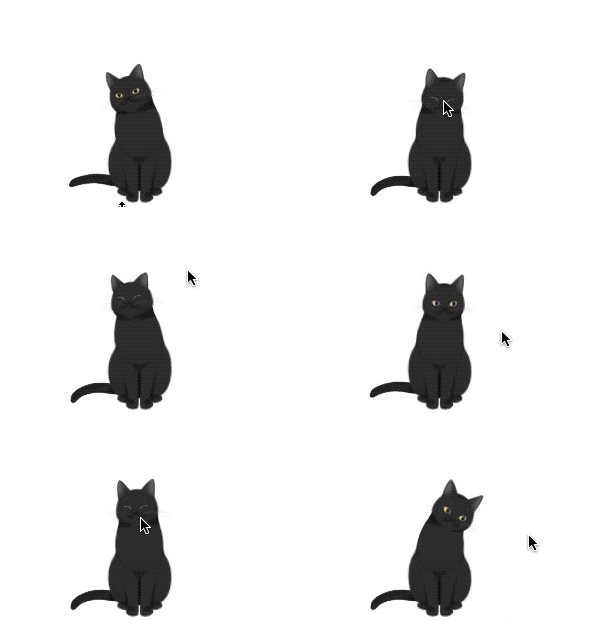
    推荐理由:对于那些由于各种各样的原因不能养猫的猫咪爱好者来说,猫能量只能通过路上看看野猫或者摸朋友家的猫来补充了。这个项目可以让你换一种方式补充猫能量,在你的浏览器页面上摆一只猫就好了。最简单的方法就是摆自己博客主页上,然后每天就能看到可爱的黑猫看着你的鼠标摇头晃脑,果然猫是最棒的。

    今日推荐英文原文:《10 Motivators That Are Not Money》作者:Jun Wu
    原文链接:https://medium.com/swlh/10-motivators-that-are-not-money-a92a509e7b9e
    推荐理由:钱是手段,而不是目的

    10 Motivators That Are Not Money

    True motivators that power our economy are more than skin deep.

    As a child who lived through a turbulent childhood alternating between poverty and lower middle class, I am someone who perpetually lived in “survival mode” in my twenties and thirties. Somehow, financial security was a huge motivating factor in my life. It became the number one goal after a certain point in my career. This trap of using “money” as a motivator does not help you grow. Instead, it traps you in a cycle of “greed” and “poverty”. This cycle of “binge” and “depravity” is the cycle of addiction.

    Most Americans who are middle class, but still live paycheck to paycheck, can relate to the anxious feeling of being in the cycle of “greed” and “poverty”.

    This cycle begins with an influx of money: profits from stocks, extra bonuses, side-gig paying off, etc.. When that money is received, these Americans purchase much-needed goods. Then, they overspend on credit cards that make them feel like the money will be paid off with money streams coming in. But, when these money streams stop abruptly, they fall into poverty from the inability to pay the high-interest rates on these credit cards.

    The Signs of Money Addiction

    One of the most important signs of a money addiction is whether or not your life revolves around money.

    Does earning money, keeping money, and using your money take most of the hours of your day?

    Are you someone who does the following?
    • Do you go to work, but you don’t enjoy your job? You work for the sole purpose of getting paid.
    • On the weekends, do you enjoy shopping, eating out, taking fancy vacations? But, you don’t remember the joys, sadness, and happiness you received from people who you were shopping with, dining with, and taking vacations with. Instead, you remember the places you’ve been to and the things that you bought.
    • When you are living paycheck to paycheck, you are often angry because you feel that you are entitled to more. When you are living in a penthouse or have enough money, you feel a bit empty and impulsive. When you are in poverty living in your parent’s house, you fall into depression.
    These are the signs that are you are living inside the money addiction cycle.

    Inside the money addiction cycle, you are not making money work for you. But, instead, all your actions you take in your life center around money.

    Understanding the Money Addiction Cycle

    The money addiction cycle stems from living for “money”. This type of lifestyle reduces your person-hood, your human-ness, and your capacity to love.

    Money is not just money. It is your currency to buy material goods.

    A money addiction is an addiction to material goods. For most people, it’s an escape mechanism. Ask yourself, are you trying to avoid issues in your life by escaping to your high paying job, or luxury lifestyle. Today, our economy enables our money addiction cycle. With every in-your-face marketing campaign, we are urged to consume. With every investment opportunity, we are primed to seek risky money moves. With every cash-back credit card issued, we are rewarded for excessive spending.

    In this type of economy, money addiction becomes the chorus line of our lives.

    But it doesn’t have to.

    Here’s the thing: the real economy is powered by so much more than the ability to produce. It is powered by innovations, inspirations, true motivators such as human kindness, creativity, and love.

    Each person who is trapped in the money addiction cycle does not live a fulfilling life. Eventually, addiction leads to mental illnesses and self-destructive behaviors.

    Then, with mental illnesses and self-destructive behaviors, your life erodes. Poverty strikes. Your poverty as a person fuels the actual poverty of material goods and vice versa.

    Money is not a problem or a goal.

    Money is simply an instrument for you to live a better life. With that instrument, you can choose what you want to do with this money.

    You don’t have to be compelled to use money unless you want to.

    So, when you need motivation in life, choose better.

    Don’t choose money. Instead, choose any of these ten motivators.

    Inspiration

    Inspiration does not have to be found in grand works of art, music from a famous composer or designs that affect subculture. Inspiration can be from mundane everyday events, and objects. Have you looked a piece of autumn leaves that’s rolling on the ground? The way they tumble with the wind often reminds me of both the significance and the insignificance of life itself.

    Innovation

    We live in an age where innovation can be found everywhere. This is all thanks to the technologists working around the world. Well-designed innovation that integrates seamlessly into your life inspires new ways of living your life. A great example is how social media changed the landscape of not just marketing, but it changed how we relate to one another in all aspects of our lives.

    Love

    Without love, we are not whole. Each of us needs a certain amount of unconditional love in our lives. Often, we are the ones that give ourselves that love. That is okay. But, it’s often inspired by how others appreciate us in our lives. A simple gesture such as a hug someone gives us amid our day reminds us to be gentle with ourselves when we fail.

    Creativity

    Creativity is a tall order. But, we don’t have to be an artist to be creative. In everyday decision making, creativity is found everywhere. How to get to point A from point B? That’s a problem that takes creativity to solve. The shortest distance is often the distance that requires the most creativity. If you are making decisions every day, you are being creative.

    Kindness

    Kindness is in the small gestures of every day. Have you forgiven someone for their minor mistakes? Have you told someone “It’s okay” and hugged them today? Both of these are small kindnesses. You are being kind when you give another person some patience, some understanding, and some leeway to come together with you.

    Nature

    Nature is different for everyone. When you live in the city, nature often means staring at the outside of buildings. The truth is that even architecture is a kind of nature. Appreciating whatever your surrounding is and letting that surrounding inspire you. When you are in a park, focus time on the trees and leaves. When you are indoors at a cafe, focus on the bustling tables and the decor. When you are in an office, focus on looking out onto the office floor or out the windows.

    Family

    We all have a family. Even if you are single and living alone, you have family. If you have just one friend and no other relatives, you have family in that one friend. If you don’t have anyone, you have family in yourself and the stories of your ancestors. Finding peace in your family gives great joy.

    Beauty

    Beauty is not only artificial or skin deep. When you notice the beauty of another person, scenery or even an event, that can inspire you into action, too. Beauty can be found in chaos, in humor, and under the most urgent circumstances. The beauty of the human spirit is often both motivating and inspiring.

    Minimalism

    Clutter clouds your senses. Minimalism respects your senses. You need your senses to learn. In minimalism, you find healthier diets, more free time, a more open mind, and more positive mindsets. Whenever possible, think about the vastness of open space, ask open questions, and focus on one or two tasks. In this minimal lifestyle, you are learning what are the most important things in life.

    Character

    Character is simply you or people as they are. Character doesn’t have to imply an iron-clad moral compass. Most of us are on our way to sharpening our characters every day. You may notice people with strong characters. But, it’s also the ones with one or two characters that you like to have that intrigues you. Let that intrigue permeate. In time, you will be that person who possesses character traits that inspires others.

    Motivation is the fuel that powers our success.

    Just look around, everyone in your life can inspire you. Everything in your life can inspire you. Notice the small details. Notice the ten motivating factors that are intrinsic in your life.

    You need money to live. Make money work for you.

    Use these ten motivators to service your life and your life’s goals. Money will follow. Then, use that money to attain more of these ten motivators. This is not a cycle of addiction. It is the cycle of fulfillment.

    What are you waiting for?
    下载开源日报APP:https://opensourcedaily.org/2579/
    加入我们:https://opensourcedaily.org/about/join/
    关注我们:https://opensourcedaily.org/about/love/
  • 开源日报第597期:《中国有嘻哈 Chinese-Hip-pop-Generation》

    2 11 月, 2019
    开源日报 每天推荐一个 GitHub 优质开源项目和一篇精选英文科技或编程文章原文,坚持阅读《开源日报》,保持每日学习的好习惯。
    今日推荐开源项目:《中国有嘻哈 Chinese-Hip-pop-Generation》
    今日推荐英文原文:《How To Give Yourself Honest Feedback As a Developer》

    今日推荐开源项目:《中国有嘻哈 Chinese-Hip-pop-Generation》传送门:GitHub链接
    推荐理由:只要有足够的技术和素材,就能够让人工智能帮你写诗——换到歌词上当然也是同理。只要给出上句,这个项目能够帮你生成有模有样的嘻哈歌词下句来,念起来意外的是有那种感觉来。现在使用人工智能写诗写文章已经是一种可行的手段了,兴许继续发展下去,缺少创造性也不再是它们水平的瓶颈,但是要模仿思考的过程,可能是它们永远都无法完成的事。
    今日推荐英文原文:《How To Give Yourself Honest Feedback As a Developer》作者:Jun Wu
    原文链接:https://medium.com/better-programming/how-to-give-yourself-honest-feedback-as-a-developer-11ace4664075
    推荐理由:用自己的标准看待自己

    How To Give Yourself Honest Feedback As a Developer

    Holding yourself accountable is the best way to learn

    We’re all creatures influenced by external validation or feedback. Ever since we were kids, our parents gave us feedback by praising or reprimanding us for the work we did. Our teachers rated us on exams and asked us questions. Now, our society rates us by the work that we do, the positions we hold, and the salary we make. In this world, there’s even now a happiness index to rate countries based on the happiness of their citizens.

    Are we going overboard with external validation? I would say yes. The best judge of yourself is your “objective” self. The problem occurs when you can’t be your “objective” self. This is why most people depend on external validation for feedback of their work and their life.
    “Be honest with yourself. The world is not honest with you. The world loves hypocrisy. When you are honest with yourself you find the road to inner peace.” — Paramahansa Yogananda
    I didn’t realize the necessity of having my “objective” self critiquing my work until an incident happened at work. For three years, I’d had stellar performance reviews. I always had only two points of improvement. This allowed me to progress through the ranks of the team until promotion time came around. Then, suddenly, there were many points of improvement in my performance review.

    You see, my managers wanted me to take on more work, and so they gave me a good performance review to give me validation and motivation. Then, when they had to make good on their promise of promotion, they didn’t want to promote me that early in my career since I was still too young. They measured me against a taller yardstick, and I came up short.

    This is how the world can be dishonest with you. The world is full of people with many agendas. Every person’s agenda may not align with yours. If their agenda doesn’t align with yours, they’ll measure you against their yardstick.

    Depending on the yardstick that they measure you against, you’ll either come out short or tall.

    Everyone will react to the feedback with different emotions. We want to improve ourselves daily. We want to live our best lives.

    Why allow others to tamper with your emotions?

    People teach mindfulness as if you can suddenly hold yourself back from reacting to other people’s feedbacks if you just breathe.

    The truth is that most of us can’t just breath our way out of negative criticism.

    You need more.

    You need a system of giving yourself honest feedback so that you can improve on yourself in your own time and in your way.

    You can incorporate other people’s feedback. But, that’s your choice. You don’t have to if you don’t want to.

    You’re the best judge of your situation, what’s important to you, and where you want to go.

    The Framework for Giving Yourself Honest Feedback

    After my incident at work, I learned that there’s a way that you can give yourself honest feedback no matter the circumstances. Using this “objective” method, you can always find your inner “objective” voice.

    1. Develop your yardstick

    To measure yourself against anything, you need a yardstick to measure against. You need to find that. This could be a person you look up to, a company you want to emulate, or a project you want to complete. But, first and foremost, you need to identify this yardstick.

    To keep my motivation high, I never set my yardstick too high. I know I’ll only be able to succeed by consistently achieving with slightly higher yardsticks each time.

    2. Test yourself against your yardstick

    Why not measure yourself against your yardstick? By measuring, you’re taking a one-dimensional approach to your skills. You’re only seeing it with one lens and one angle.

    The better way to measure is, in fact, to test yourself.

    If you want to be good at presentations, then record yourself. Your yardstick maybe a TV news anchor or a TED presenter, but by testing yourself by recording yourself, you’re not exactly measuring your abilities against your yardstick. Your yardstick is simply there as a model.

    By recording yourself, you can look at your presentation with an objective lens. Then, you can see all the angles of improvement you can make. You’ll find these angles of improvement by taking a 360-degree view of your work.

    3. Give yourself compassionate feedback

    For feedback to work, you have to say it with compassion. If you’re a terrible presenter, don’t just delete the video after you’ve viewed your horrible presentation. You’ve got to give yourself some credit just for starting this journey of improvement.

    Identify both what you did right and what you can improve upon side by side.

    Along with a list of improvements, you can also list out all the things that you did right on that presentation. This list is valuable. At a later date, you may find that you’ve implemented improvement but you’ve forgotten about the basics that you did right in the first place.

    4. Hold yourself accountable for the feedback

    The final step in making sure that you’ll implement the “improvement” list is simply to set a timeline for implementation. It helps to work one or two improvements into each practice session. For instance, each time you make a video presentation, think of one improvement you can make on your list.

    In time, with enough practice, you’ll get to all the improvements on your list.

    This way, you’ll internalize all the improvements. One day, you’ll tear up the list and be on your way. You’ll have the confidence to know that you can deliver a good presentation simply because you’ve internalized all the improvements on your list.

    The next time someone judges your performance, you’ll know that this is only someone else’s feedback.

    What’s important is your feedback about your work.

    How much someone pays you only gives you the external validation of how much they value your work against all the other people’s work.

    How much you value your own work is a different beast altogether.

    Implement your own “objective” critic to give yourself compassionate feedback you can use.

    This way, you’re always motivated to improve.

    What are you waiting for?
    下载开源日报APP:https://opensourcedaily.org/2579/
    加入我们:https://opensourcedaily.org/about/join/
    关注我们:https://opensourcedaily.org/about/love/

  • 开源日报第596期:《我怀疑你在针对我 hatetris》

    1 11 月, 2019
    开源日报 每天推荐一个 GitHub 优质开源项目和一篇精选英文科技或编程文章原文,坚持阅读《开源日报》,保持每日学习的好习惯。
    今日推荐开源项目:《我怀疑你在针对我 hatetris》
    今日推荐英文原文:《How To Find Your Creativity Again》

    今日推荐开源项目:《我怀疑你在针对我 hatetris》传送门:GitHub链接
    推荐理由:俄罗斯方块这游戏难度的增加向来都体现在下块速度的上升,但是如果换一种方法提升难度的话会如何呢?这个项目是一个故意针对你的俄罗斯方块——每一个下块的目的都是阻止你得分,你大可以自定义一些全新的方块进去,但是最后如果找不出点对策的话,依然会被程序压着打……
    今日推荐英文原文:《How To Find Your Creativity Again》作者:Tim Denning
    原文链接:https://medium.com/better-marketing/how-to-find-your-creativity-again-26abe177bccd
    推荐理由:在生活中寻找创意的方法

    How To Find Your Creativity Again

    On removing outcomes, playing games, and making every day an adventure

    The kid who was creative and read the picture book “How To Live Forever” without getting sad or picturing death was lost a long time ago. That kid was creative and could write, draw, and take his surroundings and turn them into wild dreams that not even Warner Bros could recreate in an animated movie.

    Every day was an adventure. “Choose your own adventure” books were literal guides to life with actionable advice that had to be executed on the same day it was read.

    A computer game could become reality. A sandpit could be the construction site of a one-hundred story building and that kid could drive the cement truck, operate the crane, or burn the whole thing to the ground and start again.

    That kid used to be me. I used to be creative until I wasn’t anymore.

    Everything in my life became literal. A piece of content had to serve a purpose, a book had to change my life, or an event had to give me something I didn’t already have.

    Everything had to have a purpose and that’s what killed my creativity. When you’re a child, purpose has no place in the world. Curiosity drives your life and being creative is a 4:00 a.m. habit straight out of the 4-hour workweek.

    Then suddenly you become an adult and everything has to be serious and that becomes too hard to handle. Alcohol, or junk food, or Netflix help to numb your new reality. You escape on holidays camouflaged in the excuse of being young and free and experiencing the world. Really, you’re just escaping, because of the seriousness life now has. Your childlike creativity has melted away.

    We can lose our creativity, and recently, I’ve found you can discover it again. Here’s how.

    Every Day Is an Adventure

    This is a subtle shift in thinking. Rather than waking up and thinking about your day as a to-do list of tasks you’ve got to successfully check off, try changing it slightly towards making it an adventure.

    Take a different route to work. Say something crazy. Wear a bizarre fluro jumper.

    Picture your surroundings as a fantasy world straight out of a Zelda game. Mess with logic and dream up experiences that are not real. When you find your creativity again, life feels like an adventure.

    Remove the Outcome and Replace It With Creativity

    What I’ve found kills my creativity is when I assign an outcome to an activity. If you write to produce a result, you light your creativity on fire.

    If you read a book to learn a skill, you suppress your creativity. If you watch a movie to arrive at a logical conclusion, you murder any hint of creativity the movie could have left you with. If you go somewhere with a goal in mind or an experience worth having, you blind yourself from the unexpected experience felt through activating the creative center of your mind.

    What helped me find my creativity again was treating experiences in life as opportunities to experience creativity.

    Could my mind wonder? Could this whole human experience be a simulation like Elon Musk says it is? Could my mind come up with some crazy sense of reality that is untrue, or a fantasy — and could I be okay with that scenario?

    Disconnecting from outcomes and letting experiences take place in your mind is a cool alternative worth experimenting with.

    Japanese Cartoons Like “Spirited Away”

    Finding my creativity again, that I once had as a kid, accelerated when my love for Japanese cartoons was born.

    There is something about Japanese cartoons that brings out your creativity again. The storylines are often not logical and the need to introduce the supernatural or even the bizarre is a common trait of the genre.

    The movie that made me fall in love with Japanese cartoons was “Spirited Away.” There is one scene towards the end where the main character Chihiro is traveling on a rail system that goes through the depths of the ocean to a faraway place. The scene is mesmerizing and all there is is a tram car and beautiful blue seas that seem to go on forever.

    Whatever problem you might have had before watching the movie is completely gone after this scene through the ocean. All that is left is complete admiration for the creator, Hayao Miyazaki, and his ability to demonstrate an insane level of creativity that many adults lose after childhood.

    Japanese animated movies are an excellent reminder of what adults can muster up in their brains when they rediscover childlike creativity.

    Photo by Matt Popovich on Unsplash

    Play Computer Games

    No matter what generation you come from, you’d have played at least one computer game, board game, or arcade game as a kid.

    Play that game again.

    For me, it’s Mario 64 that brings me back to being a kid. In that game, you explore vast open worlds where there are princesses that need saving, castles that tempt you to explore them, and wild characters who seek to brighten your day with their various quirks.

    The worlds in the game are stunning to look at and the puzzles that need solving require you to be creative in your approach.

    Creativity and games go together perfectly when you are looking for the child that lives inside of you.

    Read a Book From School

    My English teacher at school introduced a book to us one day that she said we’d all fall in love with. It was about witches and wizards, and I ignored her recommendation.

    Part of my frustration with her was caused by the fact that she noticed a spelling mistake written with a white-out pen on the front of my binder folder. The binder was for English class and drawn on the front was the word, “Engish.” I’d accidentally spelled the word English wrong and she pointed it out in front of the entire class, which was followed by laughter and constant reminders from my classmates.

    Eventually, I watched the Harry Potter movies and really enjoyed them. On my path to find my creativity again, I went back and read the first Harry Potter book that my English teacher told me to read and that I’d ignored.

    The experience can only be described as pure bliss on a page. Every chapter was genius and the descriptions of characters and the written dialogue were creative beyond anything I’d ever read.

    Books from school can remind us of how creative we can be when the limitations of experience, reality, and logic are removed and our minds are free to say, do, and write whatever we want.

    Creativity Reminds You of This

    • Remove the boundaries.
    • Anything is possible.
    • Be endlessly curious.
    The way to be creative again is to think back to how you were as a child when these three strategies for life were your default operating mode.

    Embrace having no boundaries, believing anything is possible and being endlessly curious. That is how you can be creative again.
    下载开源日报APP:https://opensourcedaily.org/2579/
    加入我们:https://opensourcedaily.org/about/join/
    关注我们:https://opensourcedaily.org/about/love/

←上一页
1 … 109 110 111 112 113 … 262
下一页→

Proudly powered by WordPress