• 开源镜像
  • 开源沙龙
  • 媛宝
  • 猿帅
  • 注册
  • 登录
  • 息壤开源生活方式平台
  • 加入我们

开源日报

  • 开源日报第603期:《日语 Awesome-Japanese》

    8 11 月, 2019
    开源日报 每天推荐一个 GitHub 优质开源项目和一篇精选英文科技或编程文章原文,坚持阅读《开源日报》,保持每日学习的好习惯。
    今日推荐开源项目:《日语 Awesome-Japanese》
    今日推荐英文原文:《AI Will Reinstate Direct Democracy》

    今日推荐开源项目:《日语 Awesome-Japanese》传送门:GitHub链接
    推荐理由:实在闲得无聊的时候,学点什么总是没错的,比如某种新的编程语言——或者是真正的语言。这个项目是关于学习日语的资料合集,学习真正的语言虽然与编程语言相似,不同的语言间同样有着相通的部分,但是难度可不是一个层面上的,两天时间学习编程语言可能写起来已经开始有点像样了,但是学习日语也就背熟个五十音,仅仅只是开始的一步而已,尽管学会之后好处很多,但是也要付出相应的时间和觉悟来才行。
    今日推荐英文原文:《AI Will Reinstate Direct Democracy》作者:Sukhayl Niyazov
    原文链接:https://medium.com/swlh/a-i-will-reinstate-direct-democracy-26cb9cd751de
    推荐理由:把 AI 用在政治上

    AI Will Reinstate Direct Democracy

    The case for optimism in the age of artificial intelligence

    The majority of the debates regarding the advent of artificial intelligence (AI) seems to be focused only on negative sides. AI-powered monopolies, the tyranny of the minority, jobless future, collapse of the democratic system and capitalism, global inequality, digital dictatorships — to name a few.

    Media and people tend to focus their attention on negative things only, however. AI, though it will clearly bring about many challenges, will also result in tremendous new opportunities.
    One of the biggest promises of AI is that it will signal the advent of a truly “direct” democracy.
    It will help us define what it means to be a human. It will create a society of abundance and will allow humans to stop doing tedious and dehumanizing work. It will turn emotionally charged politics into evidence-based discourse with data-driven suggestions on how to tackle our problems.

    Instead of sowing feelings of doom and gloom, we should pay more attention to how we can maximize the advantaged offered by AI and minimize its negative implications.
    Optimism is the faith that leads to achievement. Nothing can be done without hope and confidence. Helen Keller
    One of the biggest promises of AI is that it will signal the advent of a truly “direct” democracy.
    With the dawn of the AI era, we might witness the revival of the original form of democracy practised in ancient Athens — the (almost) direct rule by the people.
    Since the inception of the first democracies, democratic governance has functioned in the following way.

    Politicians present their views to the electorate and citizens elect a politician who will best advance their interests.

    However, managing the country through elected representatives is not always the best approach, because very often elected officials backtrack from their promises and deviate from the expectations of their constituents. The resulting gap between ordinary people and policymakers is often hard to bridge, leading to mutual misunderstandings and mistrust that undermine the democratic system.

    It is known that in today’s political environment, politicians are forced to sell multiple versions of themselves to different voter groups. They often tell different stories to various religious, ethnic, economic and political groups in order to increase their popularity. That is, by the way, the reason why candidates’ general speeches are boring and lack concretization: they fear that certain people will stop supporting them if they make controversial statements.

    However, with the dawn of the AI era, we might witness the revival of the original form of democracy practiced in ancient Athens — the (almost) direct rule by the people.

    In our day and age, politicians, instead of announcing their views and waiting until the electorate makes a choice, study voters’ perspectives and adjust themselves accordingly to fit the voters’ expectations.

    Candidates use machine learning and artificial intelligence to analyze data about voters’ opinions. Data drawn from citizens’ activity in social networks (and beyond) about their preferences and desires could be used to identify the true wishes of citizens.

    As politicians utilize AI techniques to analyze voters’ views, a new kind of social contract emerges, where, based on Big Data research, elected officials’ perspectives are the representation of the electorate’s views.

    When a candidate finds out that his or her platform is not a popular one among voters, he or she can change it in a manner that is geared towards people’s demands and needs.

    That is how democracy could be ultimately reinforced by the use of AI: analyzing voters’ databases would give a politician a precise image of what citizens need, thereby bridging the gap between representatives and citizens and enhancing the democratic process by de-facto reinstating the Athenian democracy, albeit in a bit different form.

    After all, politicians, in the quest for more votes, will try their best to satisfy the requirements of the electorate to win their favor.

    In the words of Pedro Domingos, a renowned AI expert, thanks to AI,
    democracy works better because the bandwidth of communication between voters and politicians increases enormously.
    The advent of the AI era will mark a turning point in the history of human evolution. It will provide us with unprecedented opportunities and pose substantial challenges.

    But let us remain optimistic — and focus on the bright side of the issue. After all, as Noam Chomsky has said,
    Optimism is a strategy for making a better future. Because unless you believe that the future can be better, you are unlikely to step up and take responsibility for making it so.

    下载开源日报APP:https://opensourcedaily.org/2579/
    加入我们:https://opensourcedaily.org/about/join/
    关注我们:https://opensourcedaily.org/about/love/

  • 开源日报第602期:《茶余饭后 Best-websites-a-programmer-should-visit》

    7 11 月, 2019
    开源日报 每天推荐一个 GitHub 优质开源项目和一篇精选英文科技或编程文章原文,坚持阅读《开源日报》,保持每日学习的好习惯。
    今日推荐开源项目:《茶余饭后 Best-websites-a-programmer-should-visit》
    今日推荐英文原文:《Too Many Conversations?》

    今日推荐开源项目:《茶余饭后 Best-websites-a-programmer-should-visit》传送门:GitHub链接
    推荐理由:闲着无聊的时候不知道看啥?这个项目应该能满足你打发时间的需求:因为要转一圈这么多网站是太久了。顾名思义,这个项目是对程序员有用的网站合集,包括学习英文,入门级项目,AI 等等,作为了解新知识的指引或者打发时间扫一眼都不错,毕竟没准哪天就会发现新的乐趣所在——这个世界上存在的东西是在太多了,即使不局限于程序员方面,多去需求别的方面的乐趣也不是坏事。
    今日推荐英文原文:《Too Many Conversations?》作者:Adam Knight
    原文链接:https://medium.com/@adampknight/too-many-conversations-945514eaa81b
    推荐理由:有一说一,经常开会真的没啥用,除非真的有这么多事情需要大家一起讨论

    Too Many Conversations?

    Is criticism of a ‘meeting culture’ undermining one of the key agile principles?

    I was at a daily stand-up not long ago and a developer gave an update that went something like this
    “Yesterday I was mostly in meetings so I didn’t get a lot of work done, I did find some time to fix a bug and do a code review.”
    thereby expressing a very clear opinion on what real ‘work’ was to them — and time spent in meetings clearly was not it.

    This wasn’t an isolated event. I heard similar updates from the same developer many times, and I’ve worked with others who also expressed similar views. The sad thing here is that all it took to achieve the label of ‘meeting’ in this person’s eyes was the presence of more than one person discussing a work related topic, or as I like to call it, a conversation.

    When Meetings go Bad

    Let me say right from the start that I believe a heavy meeting culture is a pain and impacts productivity. Long, regular meetings involving lots of people are an expensive business and can dominate the calendars of middle and senior managers if not kept in check. The perils of the meeting culture are well covered elsewhere (and I’ll include some links in the references at the end of this post as to the best pieces I’ve read on the subject), so I’ll stick here to summarising the three main issues I see with a meeting culture:
    • Too many people involved. It’s simply unnecessary, and expensive, to have everybody in every meeting. 8 people in a 1 hour meeting is a whole day of work. If the output wasn’t worth giving over an entire working day to, then there were too many people in the meeting.
    • Too long. Another challenge is allowing far too long for meetings that don’t merit the time. Parkinson’s Law relates to the fact that work expands to fill the time available, and rarely do I see this more apparent than in a 1 hour scheduled meeting.
    • Too frequent. If a meeting is regularly scheduled and you’re not making valuable decisions each time you sit, the meeting probably doesn’t need to be on repeat. Those of us in roles that interact with a lot of teams and departments find that their calendar is easily swamped when regularly scheduled meetings are a standard activity in a business.
    I’ve been personally guilty of falling into these traps on occasion, though I find that an awareness of the problem is the first step to avoiding it. What bothers me is that the ‘meetings’ the individual at the start of this post was referring to were nothing like what I’ve described here.

    Conversations aren’t meetings

    “The most efficient and effective method of conveying information to and within a development team is face-to-face conversation.”
    Despite being explicit in the 12 principles of the agile manifesto, I find that this principle is one that is most heavily resisted by some individuals. Some still persist with the opinion that unless you’re coding you’re not doing valuable work. It’s frustrating how people that are otherwise enthusiastic about agile principles would so strongly reject one aspect that is so fundamental to them.

    It’s unsurprising that the group that I’ve seen this most commonly is software developers. I reject the stereotype that developers are an antisocial bunch, but I do believe there are some pervasive practices that promote the idea that the only valuable work is coding:
    • Some of our mechanisms to measure development ‘productivity’ specifically promote at-desk coding as the sole measure of progress — yes “source lines of code” I’m primarily thinking you, however agile sprint velocity and kanban status columns can also be abused to the point of promoting the completion of tasks over the successful delivery of value.
    • Our hiring processes similarly focus predominantly on the purely technical. I’ve yet to see a developer hiring process that required a developer to actually speak to someone to establish the nuances and assumptions of a user problem before undertaking the obligatory coding challenge. More often we place a technical coding problem in front of them and rely on discussion with other deeply technical roles as the only means of assessing softer skills.
    • Having discussions raises criticisms and questions that take time to resolve. It’s much quicker to reach a solution based on how you see it working and defer critical feedback to the end than it is to have your thinking challenged up front. Discussions amongst stakeholders often expose the nasty, real-world complexities that undermine our nice elegant solution models and feel like they are slowing development progress (even though this kind of activity actually vastly reduces the effort needed during testing and review). It’s hardly surprising then that some folks prefer to avoid them.
    With these factors driving the perspective that conversation takes away from productive work, how can we promote the need for healthy interaction to support productive development?

    Rephrase the problem

    There are practical ways to reduce the negative perception of meetings. Where they are needed try to encourage sessions that are :
    • Focussed on a specific decision and just long enough to make that decision. I find it useful to focus on coming together to agree direction and identify next steps rather than trying to solve all the problems at hand in one long meeting.
    • Arranged as near to the time needed as possible. Try to organise at just the right moment to prevent blocks whilst not being so ad-hoc as to impose interruptions — people need time to plan their quiet work. If you have a daily standup (is anyone brave enough not to?!) then this is an ideal time to discuss and arrange appropriate times for any conversations needed.
    • Involving only the relevant people. Have enough people in the conversation to avoid excluding people affected, but no more. In other words — invite the testers.
    Keeping discussions lightweight, on-demand and just-long-enough will certainly help to avoid becoming an organisation that is paralysed by meeting culture. Sadly, as I’ve discovered, it won’t remove the challenge of the ‘we have too many meetings’ argument. This is a problem that needs to be addressed at the cultural as well as the practical level.

    Instead of referring to ‘meetings’ try talking about ‘conversations’ or ‘catch ups’.

    “Yesterday I had a conversation with the CTO around to decide how we were going to progress the security rollout, and a really useful catch up with Andy and Sarah to decide the final tasks needed to complete their active story.”

    This isn’t just idle semantics. The word “meeting” conjures up images of a formal event, with pre-defined parameters that is scheduled to fill an allotted time slot. Sometimes this formality is required but often it’s overkill for the needs of software development teams. We tend to use the term ‘catch-up’ in my company to imply a short, single-point agenda conversation with minimal attendees organised at the appropriate moment to make a decision. These catch ups are requested and scheduled at or just after stand-up so people can loosely plan them in on the day when they are needed. Often a catch up involves only two people, but each of those people has committed to the time to tackle the decision at hand. This commitment is key — someone wandering over to your desk or calling on Skype is an extremely effective low friction way of having discussions, but in such a situation it’s perfectly acceptable culturally to terminate the conversation suddenly for other commitments, like being overdue your 11am coffee, or hearing the sandwich van arrive. What we’re aiming for is the lowest friction, minimal impact conversation that is scheduled enough to prepare for and plan other tasks around.

    Look at who you’re hiring

    When using agile methods it’s critical to have people that respect the value of conversation in decision making, and enjoy collaborating with their colleagues to deliver value. If your team contains people who prefer to stay at their desks building poor software based on false assumptions, then you need to look at who you are hiring.

    I’m always open to being challenged, and when there has been valid argument in the ‘too many meetings’ criticisms I’ve taken it on board. Instead what I’ve seen recently was that the individuals most critical of time spent in conversations, were also the ones whose work most frequently missed the mark. They were the ones whose solutions just weren’t thought through. At best this involved having spend far more time in reworking and reviewing that was necessary, at worst it involved having to simply ditch the changes and start over. Conversation is essential in the process of having your work held to account, and avoiding scrutiny through the ‘too many meetings’ argument is disingenuous. The simple fact is that you can’t avoid scrutiny for ever and the later you leave it, the harder it hits.
    下载开源日报APP:https://opensourcedaily.org/2579/
    加入我们:https://opensourcedaily.org/about/join/
    关注我们:https://opensourcedaily.org/about/love/

  • 开源日报第601期:《天气 earth》

    6 11 月, 2019
    开源日报 每天推荐一个 GitHub 优质开源项目和一篇精选英文科技或编程文章原文,坚持阅读《开源日报》,保持每日学习的好习惯。
    今日推荐开源项目:《天气 earth》
    今日推荐英文原文:《How To Learn Any New Programming Language Quickly》

    今日推荐开源项目:《天气 earth》传送门:GitHub链接
    推荐理由:虽然看起来是个古物,但是这个项目可是实打实的想要将地球天气可视化的展现出来。天气这玩意几乎完全无法控制,所以看天气预报就显得十分重要,这个项目虽然不是天气预报,也只有风向的展示,但是这会是一个好的想法——毕竟可视化的天气预报虽然提供的信息有点偏观赏性而不是实用性,但是好看也是很重要的一部分,谁又能肯定积雨云里真的没有一大群像这些风线一样的透明鱼和云之龙什么的在里面生活呢?
    今日推荐英文原文:《How To Learn Any New Programming Language Quickly》作者:
    原文链接:https://medium.com/better-programming/how-to-learn-any-new-programming-language-quickly-94996895669b
    推荐理由:编程语言来来去去有些东西是不会变的

    How To Learn Any New Programming Language Quickly

    An essential checklist of fundamentals

    This article assumes you already know at least one programming language; however, the concepts here will help you get started with programming.

    When I was in school, a teacher told me something I share with new developers: The hardest programming language you’ll ever learn will be your second.

    Don’t let this be disheartening — it means that when you first learn how to program, you have all of these preconceived ideas about programming. You end up making more syntax connections and assumptions than you should. Because of this, you have to “unlearn” these assumptions when you learn your second language. Try to keep this in mind if you’re attempting to learn your second language or even your third.

    Anatomy of Programming

    There are a lot of programming languages, easily over 5,000, but the TIOBE index lists the top 250. All of the top 20 languages that aren’t unique cases will have similar standard libraries.

    I think the best way to think about programming is to strip out all of the extra “stuff” so you’re left with only the necessities.

    The Atoms

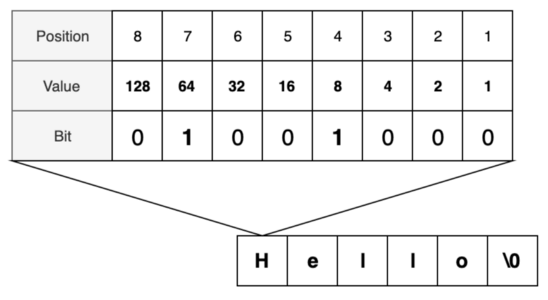
    Every aspect of every language can be reduced down to true and false. Why? Because electricity works this way — you either have a charge, or you don’t. Memory stores values in the form of 0s and 1s, and either this bit is charged, or it’s not.

    Eight bits is equivalent to one byte, which is enough to list any character on the ASCII table. The bits are flipped in such an order that it provides the DECimal representation of the character. The computer understands how to translate this representation into a letter.

    Basic binary representation showing how the word Hello is created.

    Having an understanding of this one concept, “the why,” will make the rest of this a lot easier on you.

    The Tools


    Photo by Fleur on Unsplash

    The tools are all the same, and while they can be learned in any order, this is the order I usually take.

    Variables

    This seems simple enough, but seriously, how do you create a variable?

    Operators

    What are the operators, and how are they used? You can assume you have basic math operators, but what about logical operators? Is an “AND” operator spelled out as “and” or “AND,” or does it use symbols such as “&&?”

    Conditionals

    Surprisingly, my most read articles for both Swift and Python have to do with decision making. The next thing you need to know is how you can make decisions in your program. Does the language you are trying to learn use the traditional “if/else if/else” or something more Pythonic such as “if/elif/else?” Does your language have a “switch” or “guard” statement?

    Loops

    How can you loop through repetitive tasks? Does the language contain for-loops, while loops, do-while loops, or for-each statements?

    Functions

    Is it possible to create functions? If so, how do you do it? How do you include parameters in these functions? Knowing how to properly use functions will save you time and make your life so much easier.

    Classes and structs

    Does this language understand the concept of classes or structs? It sounds like a dumb question, but some languages don’t have either, or they have only one. If it does, how do you create a class or struct? Does the class require a constructor or init method?

    Error handling

    Errors are inevitable. When they occur, does this language have a robust error handling solution and how do you use it? Is it “try/catch,” “try/except,” or something else? Are there other clauses such as “else” or “finally” that allow other options for errors?

    Testing

    How do you test your code? Is there a built-in library for testing or do you have to download a separate tool?

    All of these tools should be in most modern programming languages. Even the older languages such as COBOL have most of these, but they may be called something different, like paragraphs or copybooks.

    Getting Good

    Once you understand these tools, the next thing you need to do is use them and write an application. You can know of a language by reading the docs, but you don’t know the language until you’ve written a few applications with it.

    By writing an application, you’re forced to think like an X programmer. I can say that I know C++ because I took a class in C and read the docs on C++, but I really don’t know it until I’ve written an application in C++ using features specific to the language.

    A good starter project is Blackjack. Blackjack requires variables, operators, conditionals, loops (based on the number of players), functions, classes/structs, and error handling. You can include test cases for potential failures, such as running out of cards.

    Other good starter projects might include Shoots and Ladders, Yahtzee, or a Slot Machine.

    For something more advanced, try to recreate a game like Monopoly. Worry more about the mechanics and keep it text-based.

    It’s key to remember that if you short yourself on the difficulty of the task (such as skipping the double down or split features of blackjack), you’re only limiting your comprehension of the language.

    What Else?

    I know that the list of things above isn’t everything that a language has to offer. The truth is you can write just about anything with the tools listed above, but the additional functionality included in standard libraries just make it easier. Most standard libraries include the same functions, and so you can rely on similar names between languages.

    The more you work with a language, the more you can discover about the standard library, but be sure to learn the tools beforehand.

    As you work with a language, try to figure out what its strengths and weaknesses are. These will help you understand which language to use for a particular problem.

    Need to do some data science quickly? Look at a few Python packages or R. Need to write a fast service? Look at C or Go. How about a web server? Look at Java or Python.

    I didn’t just know this by looking at the languages. I learned this by using these languages.

    Since this is possibly my shortest article to date, I’m going to leave you with a challenge to yourself to learn a new language. Good luck!
    下载开源日报APP:https://opensourcedaily.org/2579/
    加入我们:https://opensourcedaily.org/about/join/
    关注我们:https://opensourcedaily.org/about/love/
  • 开源日报第600期:《六个字符 jsfuck》

    5 11 月, 2019
    开源日报 每天推荐一个 GitHub 优质开源项目和一篇精选英文科技或编程文章原文,坚持阅读《开源日报》,保持每日学习的好习惯。
    今日推荐开源项目:《六个字符 jsfuck》
    今日推荐英文原文:《A chaotic mind leads to chaotic code》

    今日推荐开源项目:《六个字符 jsfuck》传送门:GitHub链接
    推荐理由:一切学问的基础都是简单的,其他知识皆由简单的基础发展而来,这点在 JS 上当然适用,不过你可以把基础用一些不同的方式展现出来。这个项目可以用六种字符来完成 JS 代码的编写,听上去似乎不太可能,但是读一读原理就能明白一二,比如凭空造数这种看似离奇的操作实际上是由语言本身的原理完成的——打好基础的重要性就在于此。
    今日推荐英文原文:《A chaotic mind leads to chaotic code》作者:Dler Ari
    原文链接:https://medium.com/free-code-camp/a-chaotic-mind-leads-to-chaotic-code-e7d6962777c0
    推荐理由:适时重整自己的状态而不是带着 debuff 继续前进

    A chaotic mind leads to chaotic code


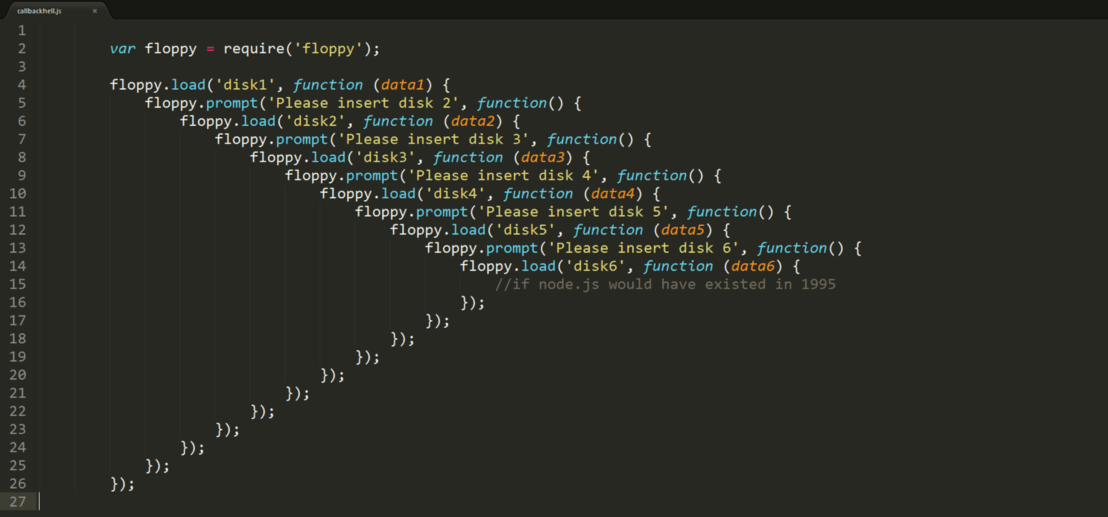
    Did not find any good example of chaotic code, but found an example of callback hell 🙂

    We live in a world with many things that consume our time, and the constant need of always doing something. And if we don’t do it, we are left behind while the world moves on.

    To stay alive and be competitive today means always checking whats new on Twitter, Reddit, Instagram, Facebook, podcasts or any other social media platforms. Or learning every JS framework out there, understanding every programming concept, and so forth. It seems that the only option is doing a dozen things.

    In the end, it all leads to a chaotic mind, and we cannot think straight anymore. We just live through each day while tasks stack up. And after a while it reduces the quality of the content we produce, such as code or other things in our day to day work.

    The focus of this article is to find effective ways to deal with a chaotic mind in order to produce high quality content. I’ll talk about few well-known concepts, and why they are important, but won’t cover the details.

    Let’s understand how the brain works!
    The brain is one of the largest and most complex organs in the human body. It’s made up of more than 100 billion nerves that communicate in trillions of connections called synapses.
    Here’s what we’ll address
    • What leads to a chaotic mind
    • Accept that it exists
    • It starts within you
    • Focus on your breathing
    • Mindfulness
    • Reward yourself

    What leads to a chaotic mind?

    A chaotic mind is simply another word for stress. If you have many things to do, and cannot prioritize the ones that are really important, you are left with an equal focus on everything, which leads to stress. There is nothing wrong with having a bit of stress, as it prepares you for challenges, and things that matter.

    However, the issue is when it takes over your mind, the things you produce, and alters the way behave. It’s not something you can get rid of, but learning how to deal with a chaotic mind helps you to make better decisions, and live in the present.

    Here are few definitions of how we end up with a chaotic mind
    1. Pressure or tension exerted on a material object.
    2. A state of mental or emotional strain or tension resulting from adverse or demanding circumstances.
    It’s not your fault that the world we live in is full of “do this, not that, but wait, you must do this!” in other words, lots of things that drain our energy.

    If you try to sit down for a second, clear your thoughts and get some work done on the computer, you’ll most probably get distracted by something on the web. And before you know it, you’ve spend a couple of minutes or maybe hours on everything except the work that matters.

    Next day, you do the same, and the day after. It seems that it’s impossible to do work without losing focus these days.

    One thing that you need to understand is that the world is built upon getting your attention, because more attention equals more money. That is a part of the business model, and how everything else works in the business world. Social media, mobile apps, TV-commercials, you name it, they are all constructed to get the most out of your time. Some do it for the better, while others don’t.

    Let’s face it, there will always be distractions, and something that takes your attention. That is why it’s important to manage a chaotic mind, otherwise you’ll just float in the middle of nowhere.

    So what exactly leads to a chaotic mind?
    • Limited time: Too many things that must be done within a specific deadline
    • Financial budget: Not able to buy the stuff you need to live a decent life
    • Friends/family: Not satisfied with what you do, too many expectations
    • Self-image: Not able to fulfill your desired goals
    These are few reasons out of many. It depends on the person, and their environment. It’s interesting that the majority of people fall under same categories that cause stress.

    Accept that it exists

    First of all, you just need to accept it. Secondly, understand that it exists, and don’t try to fight it. Thirdly, analyze how your body and mind react. It’s not easy to detect a chaotic mind. And if you are not aware of it, few things can help.

    One way to detect a chaotic mind is when the thoughts just burst around and it’s difficult to pinpoint something. If you forget things often, that may also be sign of a chaotic mind.

    Once you realize it exists, and how you react to it, you can gradually find ways to reduce it. Just to be clear, stress is normal, but it doesn’t mean it cannot be maintained for the better.

    For instance, if you drive somewhere, you might get an image where you turn the steering wheel too quickly to the left, and maybe hit someone. It does not define you, but is simply a thought out of dozens that randomly enters your mind. What defines you is the action you actually take. And thoughts like these are not unusual.

    Here are a couple of ways to reduce a chaotic mind!

    It starts within you

    It’s common for people to say that in order to reduce a chaotic mind, you need to exercise, be healthy, join a boot camp, talk to someone, be with someone, listen to podcasts and so forth. It may work. But if you think about it, these are things that point to external activities.

    Don’t get me wrong, exercising and eating healthy food is good for the mind and the body. But it’s important to realize the problem lies within you, and it’s you who must deal with the problem.

    For instance if my car needs an oil change, I don’t go and fill up more gasoline, or continue to drive. The source of the problem is that I need to change the oil, that’s it, otherwise the car will be damaged.

    Here’s the thing, always doing something doesn’t make us happier, it just takes our attention away from what we are struggling with. We need to be able to deal with emotions, deal with things that are not fun. Mike Tyson was asked once, what is the most difficult thing about training. He said, the mind.

    You can meditate all day, eat healthy food and exercise 3 times a week, but if you can’t deal with a chaotic mind, you are simply increasing the severity of the damage. Learn to deal with your emotions by accepting that they exist, and don’t avoid them!

    Focus on your breathing

    Breathing is an essential activity which supplies our body and its various organs with oxygen, which is vital for staying alive. We can live without food and water for a couple of days or maybe weeks, but if we stop breathing we die within a few minutes. There is a strong link between breathing and our mind. This is not something we really think of because most of the process happens automatically. Knowing how to breathe helps us to control our emotions, fears and keep a clear mind.

    For instance, if a programming task is too difficult to solve, your breathing becomes quick and shallow. Breathing deeply and slowly will instantly calm you down mentally as well as physically.

    So how can you know if you are breathing correctly? If you are sitting on a chair, put your hand on your stomach, and the other one on your chest, then check if your chest or stomach is moving when you inhale. If your chest is moving, then that’s not a good sign. The reason why is because the chest has limited space, which prevents maximum breathing (short cycles). On the other hand, if you do sports activities, then chest breathing is normal because you need oxygen quickly. But for non sport activities, the breathing should happen through your stomach.

    Mindfulness

    It’s about bringing awareness to what you’re directly experiencing, being aware of where you are and what you are doing, not overly reactive or overwhelmed by whats happening around you. It sounds easy to sit down for a couple of minutes and live in the present, but trust me, it’s not! We are so caught up with living in the past and the future that we simply forget to live in the present.

    Mindfulness is not something new. It’s been used for a long time, and even religions use it. Praying to god is a form of relaxation, for example, and bringing thoughts to the present. I’ve used this technique of mindfulness to clear my thoughts, and often I’ve found solutions to problems just by doing it. It’s a bit funny how we are able to find answers when we are not sitting at a desk.

    Reward yourself

    If we want an animal to do a certain thing, we give it a treat every-time it does it, and after a while, it learns and knows that in order to get the treat it must perform the action. But if we don’t want it to perform it, we either shout or spray water on the animal (not recommended). These are things that humans have used to teach animals to do certain things, for instance dolphins to do back flips, dogs to roll and even lions to jump through fire (in a circus).

    We humans are not that different from animals. It’s important that we rewards ourselves when we do good things, as this rewires the neurological pattern of the brain to keep performing the action. Buy yourself something you like, for instance a chocolate bar, energy drink or ice cream when you do something good, and you’ll continue to do it. It can also be watching a movie, your favorite series on Netflix, and so forth. Find what works for you.

    Conclusion

    A chaot mind is not something we want, and as mentioned, it leads to producing poor quality content. It first starts within you, so you need to understand how you think and react to certain things, and not try to avoid it by doing external activities all the time. Deal with your thoughts and emotions through mindfulness, breathing, and make sure you reward yourself when doing something good.

    If you understand how your mind works, you’ll be able to improve lots of things in your business as well as personal life.

    Please share if you have any good techniques on dealing with a chaotic mind.
    下载开源日报APP:https://opensourcedaily.org/2579/
    加入我们:https://opensourcedaily.org/about/join/
    关注我们:https://opensourcedaily.org/about/love/

←上一页
1 … 108 109 110 111 112 … 262
下一页→

Proudly powered by WordPress